Average purchase price explained: a practical UK guide
Average purchase price explained for UK investors: calculate your weighted average, check platform costs and understand why tax records can be different.
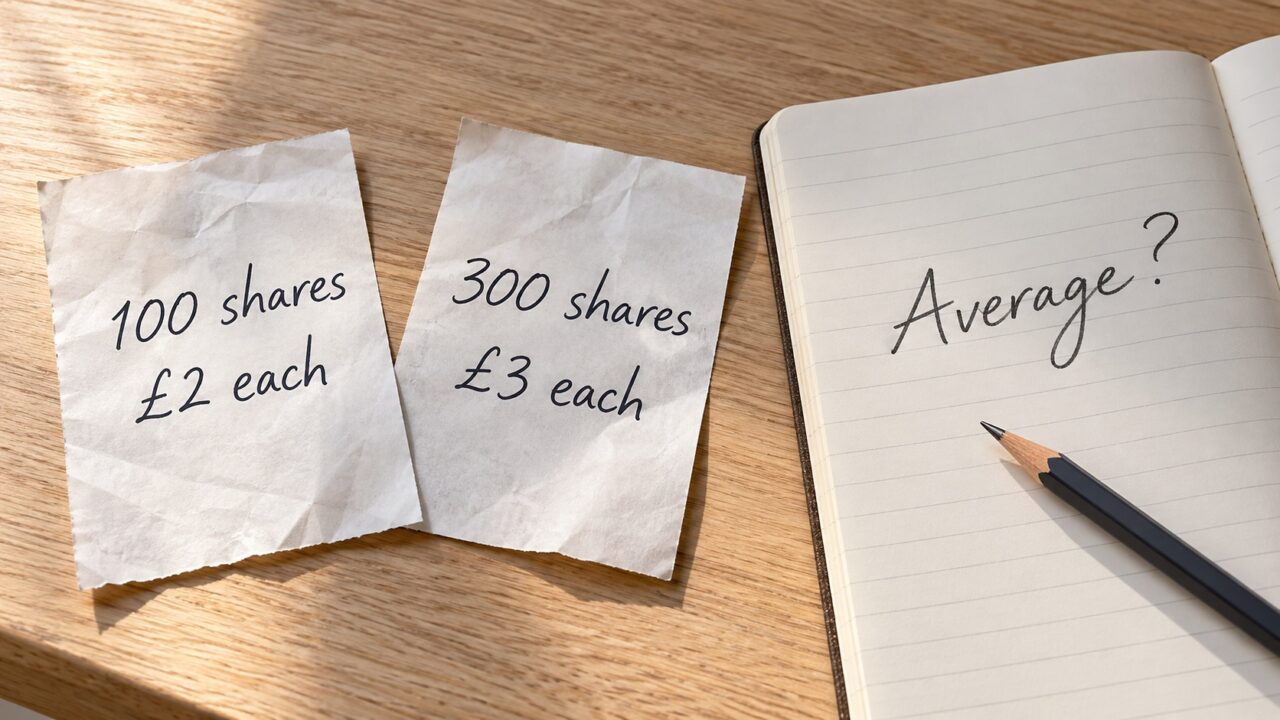
You buy the same investment twice, at different prices. Your account now shows a third number: the average purchase price. Here is how to check the arithmetic, understand the costs behind it and avoid treating one screen as your whole investment record.
What is average purchase price?
Average purchase price is the amount paid per share or fund unit, weighted by how many you bought at each price. For a holding built entirely from purchases, with no sales or other adjustments, divide the combined purchase value by the total number of shares or units.
Average purchase price = total purchase value ÷ total quantity bought.
The important word is weighted. Buying ten shares at one price and ninety at another does not give each price equal influence. The larger purchase counts more. Whether your platform also includes dealing fees, taxes or currency costs depends on the figure it is displaying.
A worked example: two purchases, one average
Imagine Alex buys shares in a fictional company. This example uses pounds throughout and initially excludes all fees, taxes, income, currency conversion and sales.
- First purchase: 100 shares at £2 each, costing £200.
- Second purchase: 300 shares at £3 each, costing £900.
- Total: 400 shares costing £1,100.
Alex’s average purchase price is £1,100 ÷ 400 = £2.75 per share. Averaging the two prices alone would give £2.50, which is wrong because Alex bought three times as many shares at £3.
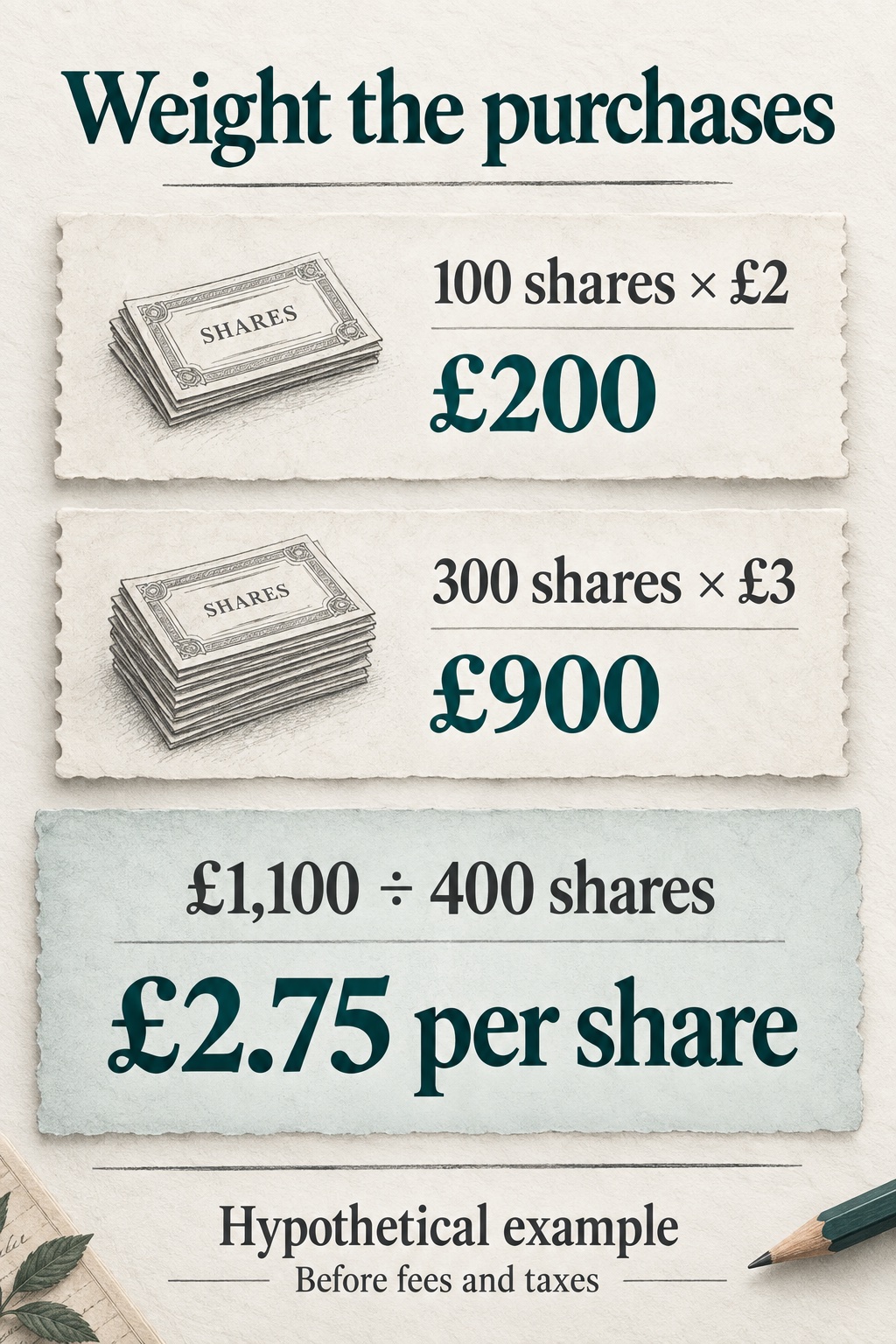
Now suppose the two purchases also incurred £12 in total buying costs. The total cash spent becomes £1,112, or £2.78 per share. The £12 is an illustrative combined cost, not a broker tariff or an assumed stamp-duty rate.
Both £2.75 and £2.78 can be meaningful. One describes the purchase prices alone; the other includes the stated buying costs. Before deciding the platform has made a mistake, find out which question its number answers.
Purchase price, book cost and profit are different things
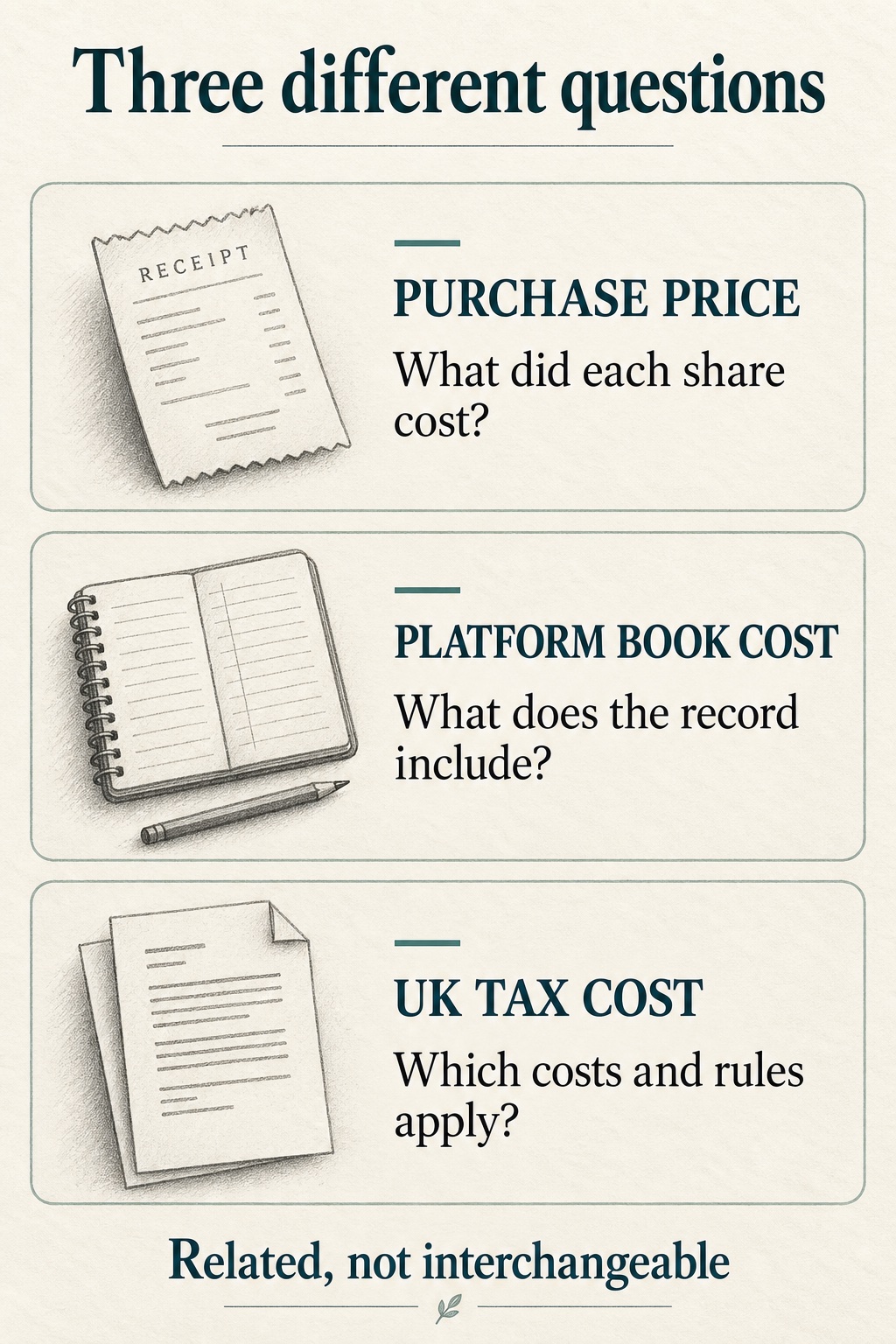
Book cost is the recorded cost assigned to an investment holding. It is usually a total amount, whereas average purchase price is a per-share or per-unit figure. Do not compare £1,112 with £2.78 without first accounting for the 400 shares.
As a concrete provider example, AJ Bell says its portfolio Cost figure includes investment-related fees such as stamp duty. That explains its label, not every platform’s calculation, and is not a recommendation to use the service.
Suppose Alex’s 400 shares are now valued at £2.90 each: £1,160 in total. Compared with £1,112 spent, that is a £48 unrealised gain, meaning a gain on paper before a sale. If selling would cost £8 and the sale actually achieved that price, proceeds after that cost would be £1,152 and the gain £40, before any tax. These are hypothetical figures, not a forecast.
A holding’s price gain also need not equal its total return. Cash dividends already received, charges paid separately and previous sales can change the wider picture. A number beside the shares you still hold may not capture your entire history.
Why the number can change or look wrong
- Fees and currency: check whether the calculation includes buying charges and whether it is in pounds or the investment’s trading currency. A dollar average alone does not tell you how many pounds you spent at different exchange rates.
- Transfers: the new platform may not have the original purchase records. AJ Bell’s guidance says its Cost can show zero if the previous provider did not supply it. Zero in that field is not evidence that the investment cost nothing.
- Sales: part of the recorded cost must be allocated to the shares sold. Do not divide every purchase you have ever made by only the shares left.
- Corporate actions: events such as share splits or reorganisations can alter quantities and recorded costs. Check the provider’s adjustment notice rather than assuming a changed average means you gained or lost money.
For example, a straightforward two-for-one split would turn Alex’s 400 shares into 800. With the same £1,112 recorded cost, the average becomes £1.39. The lower number is an arithmetic adjustment, not a bargain purchase or a return.
Why your UK tax cost may be different
A platform display is not automatically a Capital Gains Tax calculation. For ordinary shares held outside tax shelters, UK rules generally pool shares of the same class in the same company in a Section 104 holding: a running total of quantity and allowable cost.
But that pool is not always used first. HMRC’s shares helpsheet gives the matching order: same-day acquisitions, then acquisitions in the following 30 days where the residency condition applies, then the pool. Special cases can require further rules. That is why buying back shares soon after selling can change the tax calculation without being obvious from an average-price label.
GOV.UK’s gain-calculation guidance also explains allowable buying and selling costs and situations needing a different valuation. Do not assume every account charge is tax-deductible. Use transaction records and current guidance, or seek professional tax help, rather than copying the portfolio profit figure into a return.
Fund income can complicate the record
For UK unit trusts and open-ended investment companies, distinguish buying more units with a cash distribution from income retained inside accumulation units. The latter does not itself give you extra units. HMRC’s helpsheet explains that qualifying notional distributions subject to Income Tax can add to allowable expenditure for accumulation units.
There can also be equalisation, a return of part of your purchase payment associated with income accrued before you bought. HMRC explains that returned equalisation reduces the unit holder’s cost for Capital Gains Tax purposes. Use the fund’s tax statement and applicable rules, not an estimate based on its yield.
Our fund distributions guide explains these income labels. If you need to identify the exact unit class first, start with how to read a fund factsheet. This is a reason to keep good records, not to turn a simple average-price check into a complete tax calculation.
A five-minute check when the figures disagree
- Confirm the investment, share or unit class, account and currency.
- Download the transaction history and contract notes, the confirmations of executed trades.
- For a purchases-only holding, total quantity and purchase value, then calculate the weighted average.
- Check fees, taxes, transfers, sales, reinvestments and corporate actions separately.
- Ask the provider what its label includes and whether any cost history is missing. Keep evidence of any correction.
Average purchase price helps explain the past. It does not tell you whether an investment is suitable now or whether buying more is sensible. Lowering an average by adding money also increases the amount exposed to that investment. The useful next step is to reconcile the record, not trade merely to improve the number on screen.
This article is general education for UK readers, not financial, investment or tax advice. Investments can fall in value and you may get back less than you invest. Tax treatment depends on circumstances and current rules.
Header image: digitally generated conceptual still life illustrating two hypothetical purchases, not a real account or trade confirmation. Inline illustrations are explanatory, not investment recommendations.