Fund distributions explained: income, dividends and tax in the UK
Fund distributions explained for UK investors: income vs accumulation units, price changes, equalisation and tax, with examples and a practical checklist.

A payment arrives from your fund, but the holding has fallen in value. Another fund pays nothing, yet still generates taxable income. Neither is necessarily a mistake. Here is how to follow the money.
What is a fund distribution?
A fund distribution usually allocates income to its investors, although some payments can include a return of capital. Depending on the fund and share class, income may be paid out as cash or retained within the fund. A company dividend is a payment from an individual company to its shareholders; a fund can receive dividends from many companies and then make its own distributions.
The useful distinction is between income earned, cash paid and total return. They are not interchangeable. A cash payment does not, by itself, tell you how well your investment has performed, and no cash payment does not necessarily mean no income.
This guide focuses on funds held by UK individual investors, particularly unit trusts and open-ended investment companies (OEICs). These pool investors’ money and issue units or shares. Exchange-traded funds (ETFs) also have distributing and accumulating classes, but their dealing and tax reporting can differ.
Income versus accumulation: where does the money go?
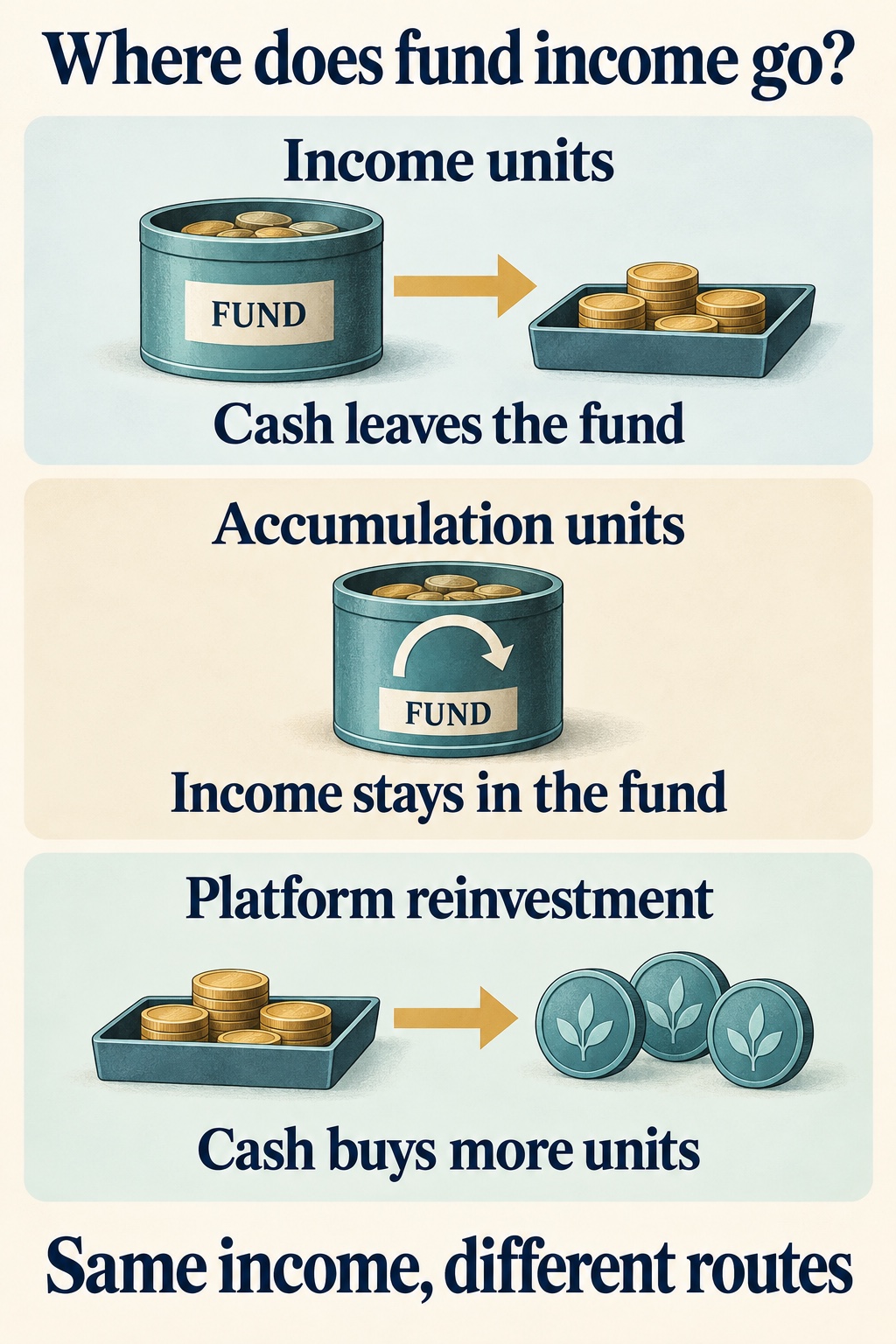
Income units, often labelled “Inc”, pay distributions out of the fund. The cash may stay in your investment account, go to your bank account or be used to buy more units, depending on your platform instructions. An income class does not necessarily mean money automatically reaches your bank.
Accumulation units, often labelled “Acc”, retain and reinvest income inside the fund. You normally keep the same number of units: the retained income is reflected in their value. It is not a separate bonus added on top of an unchanged fund price, and market losses can still outweigh that income.
HMRC’s explanation of accumulation units confirms that reinvestment does not give you new units. By contrast, a platform that reinvests a cash distribution buys additional units for you. Legal & General’s statement glossary distinguishes “income accumulated” from “income reinvested”.
Check the full class name, not just the fund name. Our guide to reading a fund factsheet shows where to check the share class, charges and investment approach. Two classes of the same fund can have different prices without one being a bargain.
Why the price can fall when income is paid
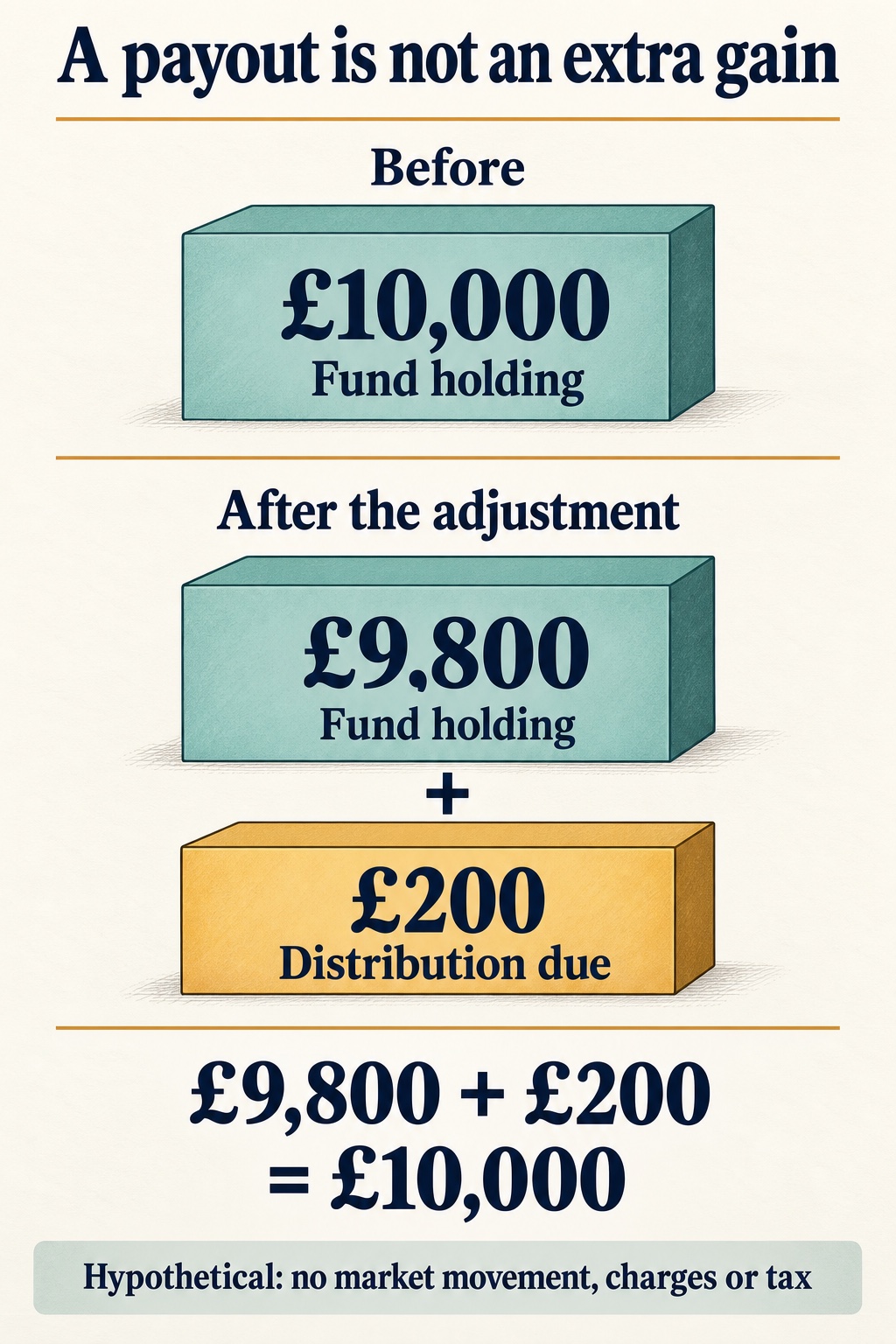
Income available for distribution is already part of a fund’s assets. When it is separated out for payment, the value remaining behind is lower. For an income class, the distribution adjustment happens when the units go ex-dividend: new purchases no longer carry entitlement to that particular distribution. The cash payment can come later.
Ignoring everything else, the unit value falls by the distribution per unit. Actual daily price movements also reflect the underlying investments, so the change you see need not equal the distribution exactly. For an ETF, its traded market price can also differ from its net asset value, the value of its assets minus liabilities per share.
Consider a hypothetical holding of 1,000 income units worth £10 each immediately before a 20p-per-unit distribution adjustment. That is £10,000, including the income about to be distributed. With no market movement, charges or tax:
- The distribution entitlement is 1,000 × £0.20 = £200.
- The adjusted unit value is £10 − £0.20 = £9.80.
- The holding is now worth £9,800, alongside the £200 receivable, which becomes cash when paid.
- The combined value is still £10,000, not £10,200.
This is a snapshot of the distribution adjustment, not a claim that the fund earned nothing over the year. The income was earned before the snapshot. Buying just before the cut-off does not create an instant profit: you pay for assets that include the accrued income.
Three dates to check before chasing a missing payment
- Ex-dividend date: the fund starts dealing without entitlement to the upcoming distribution.
- Record date: the fund identifies registered holders entitled to the distribution.
- Payment date: the distribution is due to be paid. Your platform’s processing can affect when it appears in your account.
Use your fund’s published timetable and your platform’s dealing rules. Do not assume that submitting a purchase on the record date qualifies you: order cut-offs, pricing and settlement matter. Nor does a quarterly payment schedule guarantee four equal payments.
If you hold Acc units, looking for a cash credit may be the wrong test. If you hold Inc units, check both the cash ledger and any reinvestment transactions. Match the exact class, the relevant number of units and the distribution amount per unit before concluding that something is missing.
Not every fund payment is a dividend
An equity fund commonly makes dividend distributions. A fund investing mainly in bonds or other qualifying interest-bearing assets may make interest distributions, with different tax treatment. The classification follows the applicable rules, not whichever label sounds most familiar.
For UK authorised investment funds, HMRC sets a qualifying-investments test for interest distributions. You do not need to reconstruct that test from a factsheet: use the fund’s distribution statement or tax certificate. Specialist property funds can have further categories, so a line labelled “property income” needs its own treatment.
Equalisation: why part of a payment is not income
Some funds use equalisation when you buy during an income period. Your purchase price includes income already built up before you joined. Part of your first payment may therefore return that amount, rather than represent income earned during your ownership.
For example, suppose a statement splits a £40 payment into £28 income and £12 equalisation. The £12 is not an extra dividend. For the UK unit-trust treatment described by HMRC’s equalisation guidance, it is a return of part of the purchase price and reduces the acquisition cost used to calculate a later capital gain.
In a simplified taxable-account example, units bought for £1,000 would have a £988 cost after that £12 adjustment, before any other relevant adjustments. Do not deduct the whole £40. Keep the provider’s breakdown rather than treating every pound received as dividend income or estimating equalisation yourself.
Tax: no cash does not always mean no taxable income
In a general investment account, accumulated income can be taxable even though nothing reaches your cash balance. Reinvesting a cash distribution does not remove its potential tax liability either. What you owe depends on the income type, available allowances and your circumstances.
For UK accumulation units, HMRC calls retained income a notional distribution. Its HS284 guidance says notional distributions subject to Income Tax can be added to acquisition expenditure for Capital Gains Tax purposes. Keep those records so income is not counted again as a capital gain. This adjustment is different from equalisation, which reduces acquisition cost.
Investments within an ISA are sheltered from UK tax on investment income and capital gains. A pension also generally shelters investment income and gains while invested, but pension withdrawals have separate tax rules. The account wrapper does not change whether your chosen fund class pays cash or retains income, and overseas withholding taxes can still affect a fund’s returns.
For funds based outside the UK, including many ETFs, check for excess reportable income: income reported for UK tax purposes beyond the cash distributed. This can affect distributing as well as accumulating classes. Vanguard’s tax-reporting guidance explains where its investors find the relevant reports. Use the documents for your actual holding; a cash ledger alone may not capture everything.
Judge the result, not just the payout
Total return combines the change in investment value with income. A fund can pay an attractive distribution and still lose money overall. A high quoted yield can also reflect a falling price, rather than an improving investment.
For a simple one-year illustration with no additional contributions or withdrawals, a £10,000 holding that finishes at £9,300 after paying £400 has a combined value of £9,700: a 3% loss before personal tax. The £400 payout is real, but it does not turn that loss into a gain. Published fund total-return figures typically assume reinvestment, so read their calculation basis before comparing them with your own cash-taking account.
Whether you need spendable cash or want income retained is a separate question from whether the investments are suitable. Inc and Acc labels do not measure safety. Our fund risk ratings guide explains what a risk score can, and cannot, tell you.
Your five-minute distribution check
- Identify the holding. Record the exact fund, share class and account wrapper.
- Follow the income. Is it retained inside the fund, paid to cash or reinvested by your platform?
- Match the timetable. Check the ex-dividend, record and payment dates against the transaction history.
- Keep the breakdown. Save distribution statements, equalisation figures and tax reports, including any offshore reporting information.
- Check the whole result. Look at the holding’s value and income together, not the payout in isolation.
If something still does not reconcile, ask the platform a specific question: “For this share class and distribution period, how many units qualified, what amount per unit was allocated, and where is it shown?” That is much easier to resolve than “Where is my dividend?”
In plain English: a fund payment moves value; it does not create value on payment day. Follow where the income went, then check what kind of income it was.
This article is general education for UK readers, not personal investment or tax advice. Investments and their income can fall as well as rise, and you may get back less than you invest. Tax treatment depends on circumstances and can change. Seek qualified advice if your position is unclear.
Header image: digitally generated conceptual still life created for Cristoniq, not a photograph of a real investment account or fund document. Inline illustrations are explanatory; their figures are hypothetical.