The 5 Minute AI Brief: Get a Useful First Draft
An AI brief helps teams get a better first draft with less oversharing. Learn the six parts, review checks and workplace redaction habits that matter.
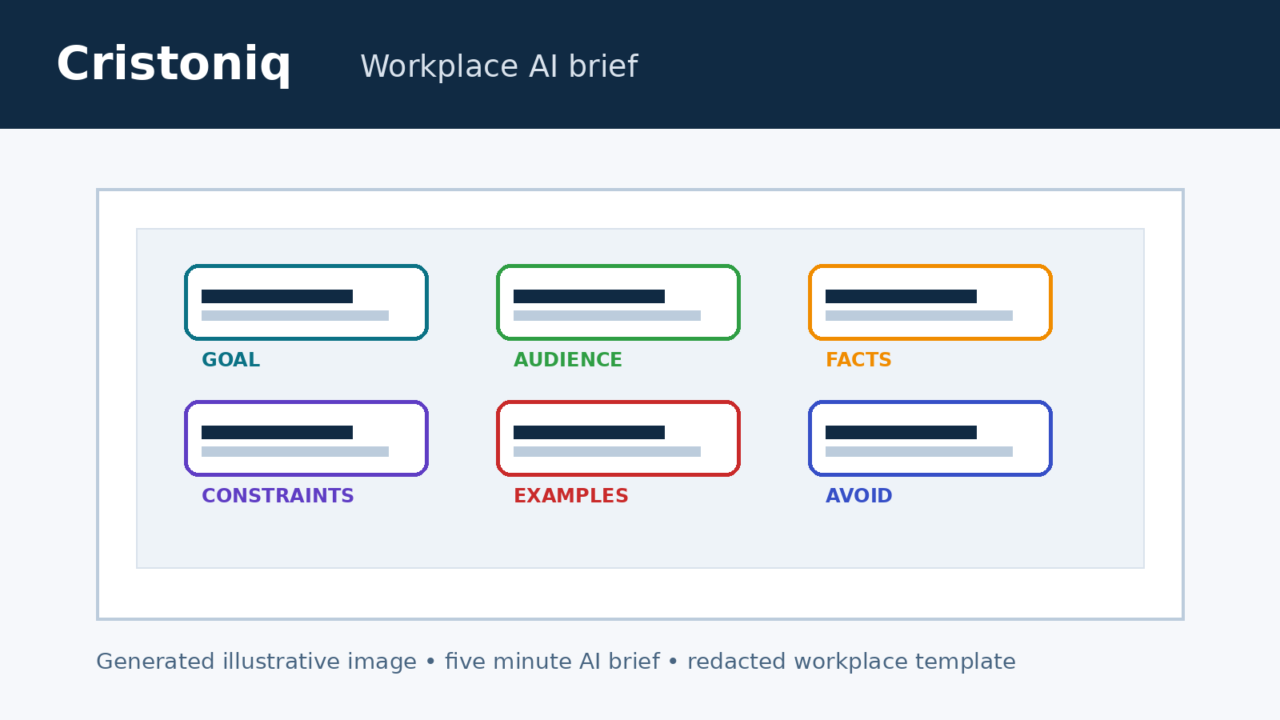
A useful AI draft usually starts before the prompt is written. The five minute AI brief gives a busy team enough structure to get a solid first version without sharing more information than the work requires.
The Short Version
- A five minute AI brief works because it gives the tool the goal, audience, facts, constraints, examples and avoid-list up front.
- The brief should reduce guesswork, not dump raw internal material into the prompt.
- Redaction and human review matter as much as better wording, especially for workplace updates and customer-facing drafts.
- If a draft could affect people, money, rights or trust, treat AI as drafting support and keep the final decision with a human reviewer.
The workplace problem
Most teams discover the same pattern after the first burst of enthusiasm. Someone asks an AI tool to draft an update, policy note, customer reply, meeting summary or project proposal. The output is fluent, but it misses the point. It talks to the wrong audience, invents context, smooths over the awkward trade off, or sounds like a generic brochure. The team then spends longer correcting the draft than it would have spent writing a clearer brief.
The problem is rarely that the tool cannot write. It is that the tool has been asked to guess. A vague instruction such as write a professional update about the project leaves too many open questions. What is the update for? Who will read it? Which facts are settled? Which facts are still uncertain? What should the reader do after reading? What must the draft avoid saying? If those answers are not supplied, the model fills gaps with likely patterns.
There is a safety problem as well as a quality problem. Rushed workers often paste in raw emails, customer records, financial notes, HR comments or internal meeting transcripts because it feels quicker than cleaning the material first. That can expose confidential information, personal data or commercially sensitive detail. Even when the tool is approved by the organisation, the principle is the same: share the minimum useful context, not the whole folder.
A five minute brief is a practical compromise. It is short enough to use during a normal working day, but structured enough to reduce rework. The reader can use it as a checklist before asking for any first draft, especially when the output will be reviewed by colleagues, customers or managers.
A practical playbook
The playbook has six parts: goal, audience, facts, constraints, examples and what to avoid. You can write them as bullets. The point is not to create a perfect prompt. The point is to remove the most common reasons that first drafts fail.
- Goal. Write one sentence that says what the draft must achieve. Use a clear verb: summarise, explain, compare, propose, apologise, brief, challenge or request. A draft that must help a manager decide needs different evidence from a draft that must help a new starter understand.
- Audience. Name the reader and their context. Are they senior leaders, a project team, a customer, a supplier or a colleague who missed a meeting? Say what they already know and what they may not know. Tone follows audience, so do not leave the tool to guess it.
- Facts. List only the facts the draft may rely on. Keep them short. Use neutral wording. If a number is not final, label it as provisional. If a date is tentative, say so. Do not paste raw documents when three cleaned bullets will do.
- Constraints. State the format, length, deadline, reading level and required style. If the draft must avoid legal certainty, investment advice, medical advice or HR judgement, say so. If it must not mention a customer name, project code or personal detail, say that too.
- Examples. Give one example of the kind of output you want. This can be a previous update, a short paragraph in the right tone, or a mini outline. Examples are especially useful when a team has a house style that is hard to describe.
- What to avoid. List the traps. Avoid claiming a decision has been made. Avoid promising delivery. Avoid naming individuals. Avoid turning uncertainty into confidence. Avoid long introductions. This section protects the draft from sounding polished but wrong.
Before you send the brief, run a redaction pass. Replace names with roles where possible: customer A, account manager, finance lead, supplier. Remove direct identifiers, private notes, exact salary figures, personal health information and anything that would be uncomfortable if repeated in the final draft. For many workplace tasks, the model does not need the name. It needs the relationship, the constraint and the desired outcome.
A good brief also separates facts from instructions. Facts are the source material. Instructions tell the tool how to use them. If those are mixed together, the output can become muddy. Keep the brief simple: first the task, then the cleaned facts, then the constraints. That structure gives the draft a spine.
There is a useful test for the brief itself. If a colleague who knows the work could read the six bullets and predict the shape of the draft, the brief is probably clear enough. If they would still need to ask who it is for, what has been agreed, what is off limits or what action the reader should take, the brief is not ready yet.
For teams that use AI to summarise meetings, the same discipline applies. Cristoniq’s guide to AI meeting transcription consent is a useful reminder that workplace AI starts with permission, context and careful handling of sensitive material, not just a clever prompt.
What This Means For You
Do not treat the first draft as safe just because it reads well. Read it once for the message, once for the facts and once for risk. The message check asks whether the reader would know what to do next. The facts check asks whether every number, date, name, commitment and causal claim came from the brief. The risk check asks what could go wrong if the draft were forwarded without another review.
Use a short review list before sharing an AI-assisted draft:
- Accuracy: Does every factual statement have a source in the cleaned brief or in a document you have verified?
- Completeness: Has the draft left out a condition, exception, deadline or dependency that matters?
- Tone: Does it sound like the right person or team, not a generic corporate template?
- Data exposure: Has any confidential, personal or customer-specific detail slipped into the text unnecessarily?
- Decision risk: Could a reader mistake this draft for an approved decision, legal position, HR conclusion, financial recommendation or customer commitment?
High-consequence work needs a harder boundary. Do not ask a general AI tool to make decisions about hiring, firing, lending, medical treatment, customer eligibility, disciplinary action, regulatory interpretation or safety-critical work. It can help organise material for a qualified human, but it should not become the decision maker. The brief should say when the output is for drafting support only and who must review it.
Teams should also agree where AI drafts are allowed. A low-risk internal update is different from a customer complaint response or a board paper. If the draft touches personal data, customer outcomes, security incidents, regulated advice or legal commitments, the review route should be explicit before the prompt is written.
Where teams get caught out
The first trap is oversharing. People paste everything because they want a better answer. That often creates a worse brief. The model receives too much irrelevant material, and the worker loses sight of what was sensitive. A cleaner approach is to summarise the relevant facts yourself, remove identifiers and state the decision context.
The second trap is hiding uncertainty. If the team is not sure whether a date is final, the brief should say so. If the customer issue is still under investigation, the brief should say that. AI tools tend to produce confident prose, so uncertainty must be included deliberately. Otherwise the draft can turn a working assumption into a promise.
The third trap is asking for style before substance. A prompt such as make this sound more professional can polish a weak argument. It may remove useful friction, soften a warning or make an unresolved issue sound settled. Ask for structure and clarity first. Ask for tone second.
The fourth trap is using examples without boundaries. Examples are powerful because they show the model what good looks like, but they can also smuggle in old commitments, outdated policies or inappropriate phrasing. If you include an example, say which parts to copy and which parts to ignore.
The fifth trap is treating all workplace AI tasks as equal. Drafting a team lunch announcement is not the same as drafting a redundancy note, a customer eligibility explanation or a security incident update. The more the draft affects people, money, rights, safety or trust, the more human review it needs.
A simple team example
Imagine an operations manager needs a first draft of an internal update about a delayed supplier rollout. A weak brief might say: Write a professional update about the supplier delay and say we are working on it. That is fast, but it gives the tool almost nothing useful. It may invent reasons, overpromise the recovery plan or sound evasive.
A better five minute brief would look like this:
- Goal: Draft a 250 word internal update explaining a supplier rollout delay and what happens next.
- Audience: Regional managers who need to answer staff questions. They know the rollout exists but not the latest delay.
- Facts: The supplier found a configuration issue during testing. The original Monday launch is paused. A revised date will be confirmed after Friday testing. No customer data has been affected.
- Constraints: Do not blame the supplier. Do not promise a new date. Do not mention individual engineer names. Keep the tone calm and practical.
- Example: Use the style of a short operations bulletin: direct, plain and action-focused.
- Avoid: Do not say the issue is resolved. Do not say there is no risk. Do not use technical detail that frontline teams cannot explain.
That brief gives the model enough to produce a useful first draft. It also protects the team from common mistakes. The draft can still be wrong, but the errors are easier to spot because the intended facts and limits are visible. The reader knows what the update is meant to do, and the reviewer can compare the output against the brief instead of judging it by polish alone.
The final step is to keep the brief with the draft. When someone reviews the output, they should see the source bullets, not just the polished text. That habit makes AI-assisted writing more auditable. It also teaches the team which prompts work, which facts are often missing and which risks need a standard warning.
In Plain English
A useful AI draft starts with a cleaner brief, not a cleverer last-minute prompt. Tell the tool what the draft is for, what facts it may use, what it must avoid and who still has to review it. That is what turns AI from a guess machine into a safer first-draft tool.
Related Reads
If your team uses AI to support people decisions, start with Cristoniq’s guide to AI performance feedback. For day-to-day policy habits, read when to disclose AI use at work before deciding how much AI involvement belongs in a draft.
The useful habit is simple: brief less, but brief better. Share the smallest safe set of facts, state the job clearly, name the limits and review the output against the brief. That will not make every draft publishable first time, but it gives teams a safer and faster starting point.