Small-cap RNS warning signs: what changed since the last update?
Compare small-cap RNS updates for changed deadlines, missing figures and funding conditions. Learn what the evidence shows, and what it cannot tell you.

“Progress continues” can sound reassuring until you put it beside the promised launch date. The useful question is not whether an announcement sounds positive. It is what has changed since the company last explained its position.
The short version
Small-cap RNS warning signs are reasons to investigate, not instructions to sell. Compare successive announcements for changed deadlines, missing measures and new funding conditions. Keep the company’s stated facts separate from your interpretation. A cautious phrase, a director’s departure or a Friday timestamp does not, by itself, establish financial trouble or misconduct.
Start with the document, then compare the promise
RNS, the Regulatory News Service, distributes company announcements. LSEG describes its regulatory disclosure service alongside Reach, its service for non-regulatory communications. Check which kind of announcement you are reading. A distribution channel is not an independent audit of the company’s claims.
Open the full announcement through the company’s investor-relations page or the London Stock Exchange’s news search, rather than relying on a headline or screenshot. Confirm the issuer, release date, reporting period and whether a later correction supersedes it.
Then find the previous update about the same subject and the latest results. Comparing a short contract notice with a full annual report will produce plenty of apparent omissions. Compare like with like before deciding that something has disappeared.
Save three things: the earlier claim, the new wording and the unanswered question. For a promised product launch, that question might be whether the date has moved, what caused the delay and whether the cash needed to reach launch has changed. That is more useful than collecting adjectives.
Four changes worth investigating
A deadline moves without an explanation. Compare the promised date with the new timetable, checking which months a quarter covers: a company’s financial year may not follow the calendar year. Look for the cause, remaining dependencies and any revised cost. A delay can be manageable; the point is to understand its consequences, not assume a failed business.
A measurable claim becomes a broad reassurance. If a comparable update replaces customer numbers or a stated target with “commercial momentum”, look for the missing figure in the results, notes or accompanying presentation. If it is still absent, record “not disclosed here”, not “must have fallen”. “In line with expectations” also needs a reference: whose expectations, for which measure and which period?
The yardstick changes. “Adjusted profit” is not automatically comparable with last year’s reported profit. An alternative performance measure is a company-presented measure outside the relevant accounting framework. In its 2021 review of these measures, the Financial Reporting Council called for clear definitions, transparent calculations and links to accounting results. Read the reconciliation, which shows how one measure relates to another. Check whether definitions, exclusions and comparison periods have changed before calling the new number an improvement.
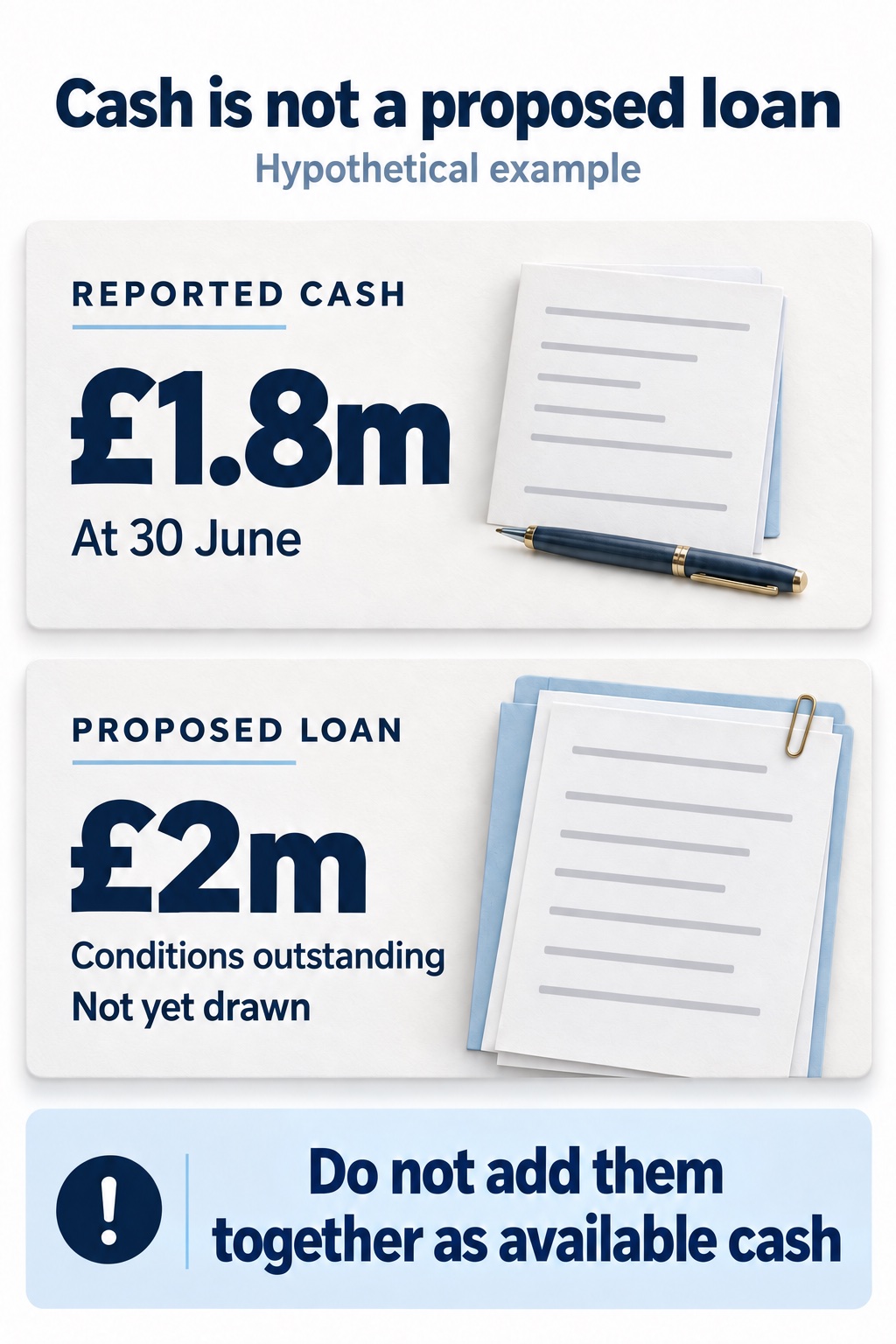
Funding becomes conditional. “Discussions are progressing”, “a facility has been agreed subject to conditions” and “funds have been received” are different statements. Read what must happen before money is usable, the relevant dates and any restrictions. A proposed loan is not cash already in the bank. A placing, where a company issues shares to investors, may supply cash but also change existing shareholders’ percentage ownership. Neither financing route is automatically good or bad without its terms.
A worked comparison: a later launch and unfinished funding
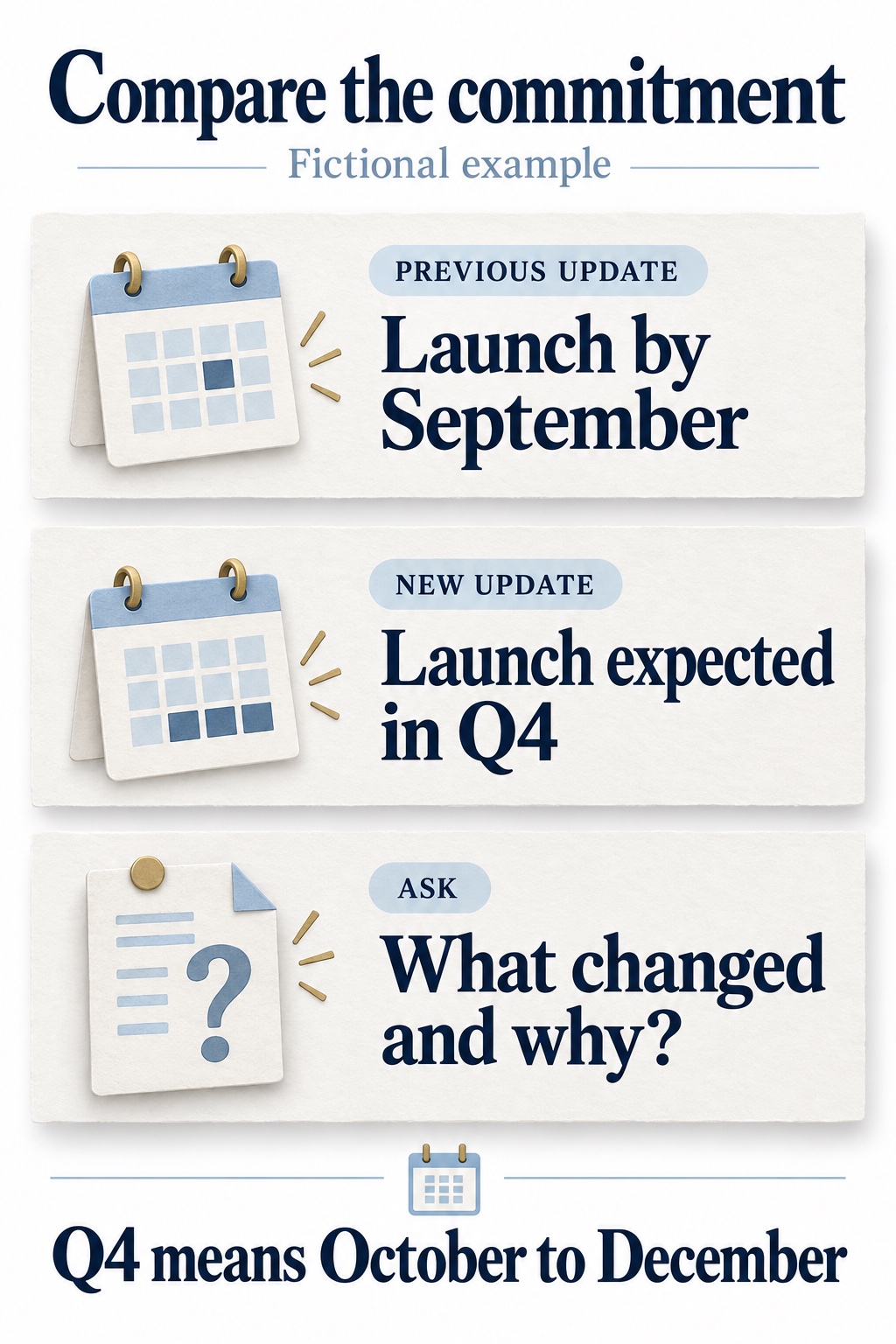
Consider two fictional updates from the same small company, which uses calendar-year quarters: Q4 means October to December. These are invented teaching examples, not extracts from a real issuer or a prediction about any share.
| 15 January update | 15 July update | What to investigate |
|---|---|---|
| “Launch by September.” | “Launch expected in Q4.” | Why has the timetable moved, and what still needs to happen? |
| Cash of £3m at 31 December. | Cash of £1.8m at 30 June. | What explains the £1.2m reduction over six months? |
| No new loan mentioned. | Proposed £2m loan, conditional on customer approval of the product; not yet drawn. | What are the conditions and when could the money become usable? |
The launch has moved beyond September, cash at the stated dates is lower and the proposed loan is not yet available. Those are supported observations within the example. They do not establish why cash fell, whether approval will arrive or whether the company can fund the revised timetable.
Do not turn £3m minus £1.8m into a confident cash-runway forecast. Cash runway estimates how long available cash might last under stated assumptions about future spending and receipts. The £1.2m difference is a change in the balance, not necessarily recurring operating spending. Borrowing, investment and customer-payment timing can affect it. The IFRS Foundation’s IAS 7 overview distinguishes operating, investing and financing cash flows and explains adjustments between profit and operating cash flow. Start with the cash-flow statement and financing notes, not a straight-line guess.
Nor should you call the company funded with £3.8m by adding the proposed £2m loan to the reported £1.8m. One is conditional funding; the other is a dated cash balance, not necessarily today’s unrestricted cash. The practical question is whether available resources cover the revised plan, including commitments due before any new funding arrives.
What wording, timing and board changes cannot prove
“Strategic review” or “transformational opportunity” should lead you to the concrete proposal, costs and conditions. They are not a code that reliably translates into failure. Equally, plain wording is not proof that a business is healthy.
A Friday release deserves the same careful reading as a Monday release. The FCA’s UK Market Abuse Regulation overview says issuers in scope must disclose inside information that directly concerns them as soon as possible, with delay permitted only under specified conditions. Inside information is a defined category, broadly involving precise, non-public information likely to affect prices significantly. This is not a rule requiring an announcement about every business development.
The timestamp alone cannot tell you why an announcement appeared then or whether disclosure duties were met. A quiet period does not establish that nothing is happening either. For claims circulating outside formal disclosures, our rumour versus RNS guide explains how to separate an attributable statement from inference.
A finance director’s departure merits reading the stated reason, handover arrangements and replacement plans alongside the accounts. It does not demonstrate hidden losses. A volume spike or director’s share purchase also cannot prove an undisclosed explanation or guarantee future performance. Record the observation without inventing the motive.
Finish with questions, not a red-flag score
Three weak clues are not necessarily stronger than one clear disclosure. Do not count adjectives, a missed date and a related funding change as three independent proofs of a collapse.
Expand your three-part note of the earlier claim, new wording and unanswered question by adding the possible consequence and next check:
- Previous claim: exact wording, date and reporting period.
- New evidence: what changed, including definitions and conditions.
- Consequence: what the change could mean, clearly marked as interpretation.
- Unknown: the specific point the documents do not answer.
- Next check: the stated milestone, results date or subsequent announcement that could resolve it.
If no next date is given, write that down rather than invent one. You can ask investor relations where an existing public explanation can be found, without expecting unpublished price-sensitive information. This method improves the quality of your questions. It does not calculate a fair share price or tell you whether to buy, hold or sell.
In plain English: read the latest announcement beside the last relevant promise. Find the change, test its consequences and leave unresolved questions unresolved. The useful warning is the evidenced gap, not the ominous-sounding word.
This post is adapted from The Little Book of Small-Caps. Used with permission.
This article is for general financial education, not personal investment advice. Investments can fall as well as rise, and individual shares can lose all their value. Consider your circumstances and seek an appropriately authorised financial adviser if you need personal advice.