Position sizing in small-caps: what a loss means in pounds
Understand small-cap position sizing with worked examples of portfolio losses, price gaps and shared risks. See why a planned exit is not a loss guarantee.

A share falls by 30%. That tells you what happened to the share, not what happened to your savings. The missing number is how much of your portfolio you put into it.
The short version
Position sizing means deciding how much of your portfolio one holding represents. A smaller holding reduces that company’s direct impact on the portfolio, but it does not make the company safer or guarantee an affordable loss.
Small-cap companies have relatively small stock-market valuations, not necessarily low prices per share. Consider three things together: the amount exposed, what a severe loss would mean in pounds, and whether you could actually sell when you wanted to. There is no allocation percentage that is suitable for everyone.
Start with the whole portfolio, not the share price
A position’s weight is its current value divided by the current portfolio value, multiplied by 100. A £2,000 holding in a £50,000 portfolio has a 4% weight. A £10,000 holding has a 20% weight. A low price per share does not make either position a small commitment.
Be consistent about the denominator. Here, “portfolio” means the investments and investment cash being assessed together, not a household’s home, emergency reserve or future earnings. Looking only at one trading account can hide exposure held in another account or through a fund.
Position size is not the same as leverage. Buying ordinary shares outright with your own cash does not become leveraged investing merely because the company is small or volatile. Leverage increases exposure through borrowing or particular financial instruments, as the US SEC’s educational explanation describes. Its US account rules are not UK guidance. These examples use no borrowing, derivatives or short selling.
One share-price fall, two different outcomes
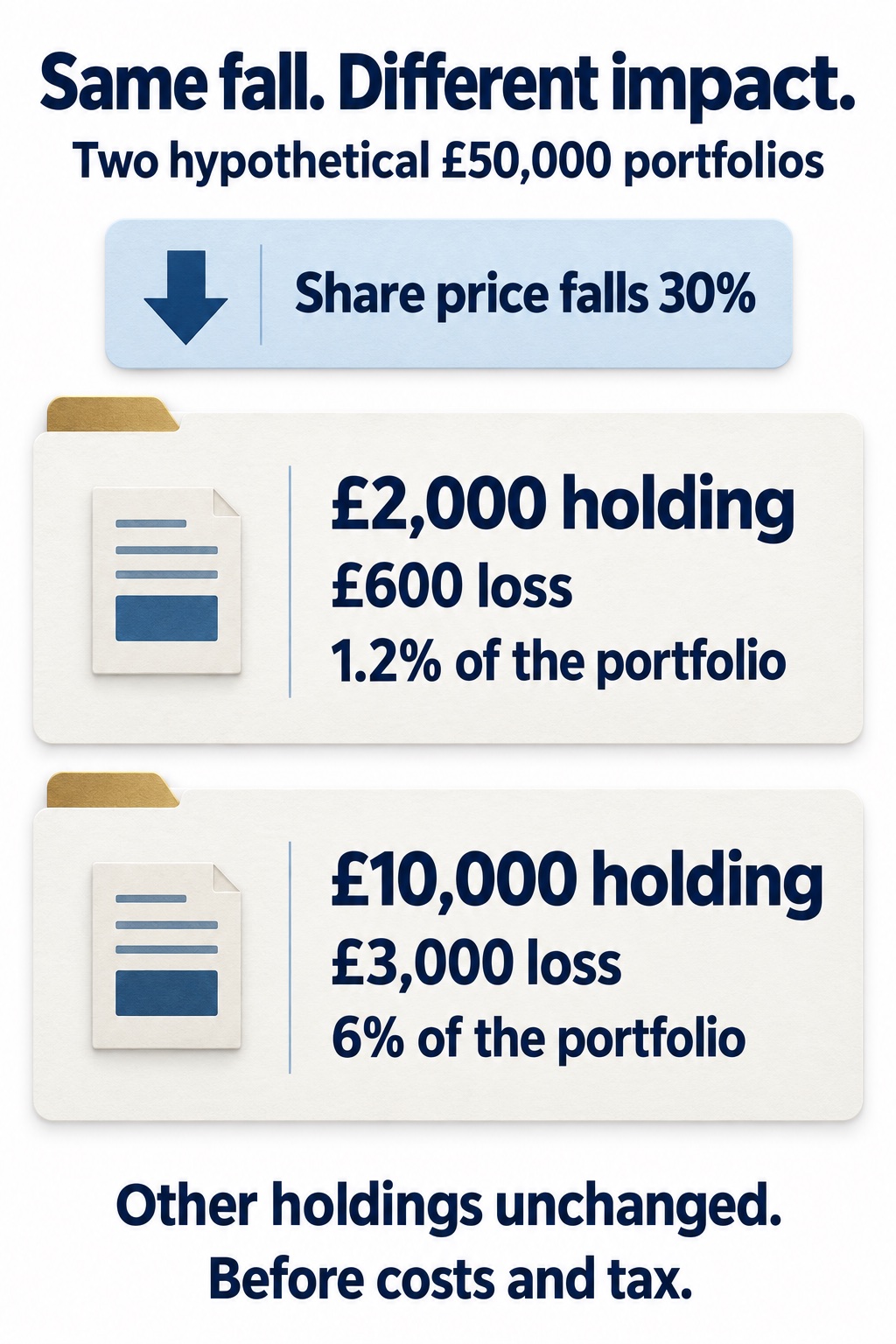
Consider two hypothetical £50,000 portfolios. One holds £2,000 in a company; the other holds £10,000 in the same company. Everything else stays unchanged. The table shows losses against each portfolio’s starting value, before dealing charges, tax, income or any cash flows.
| Share falls by | £2,000 holding | £10,000 holding |
|---|---|---|
| 30% | £600 1.2% of portfolio |
£3,000 6% of portfolio |
| 60% | £1,200 2.4% of portfolio |
£6,000 12% of portfolio |
| 100% | £2,000 4% of portfolio |
£10,000 20% of portfolio |
The calculation is holding value × assumed percentage fall = pound loss. Divide that loss by the starting portfolio value to find its portfolio impact. For the first row, £2,000 × 30% = £600; £600 ÷ £50,000 = 1.2%.
These are scenarios, not forecasts or recommended weights. The 30% and 60% cases are not worst-case limits. A fully paid ordinary share can become worthless. Whether a £600 or £2,000 loss is manageable depends on the person’s finances and goals, not on whether the percentage looks small.
A planned loss is not a maximum loss
You may see position-sizing calculations based on an intended exit price: divide a chosen pound-loss budget by the difference between entry and exit prices to obtain a share quantity. The arithmetic describes that assumed execution. It does not reserve a buyer at the exit price.
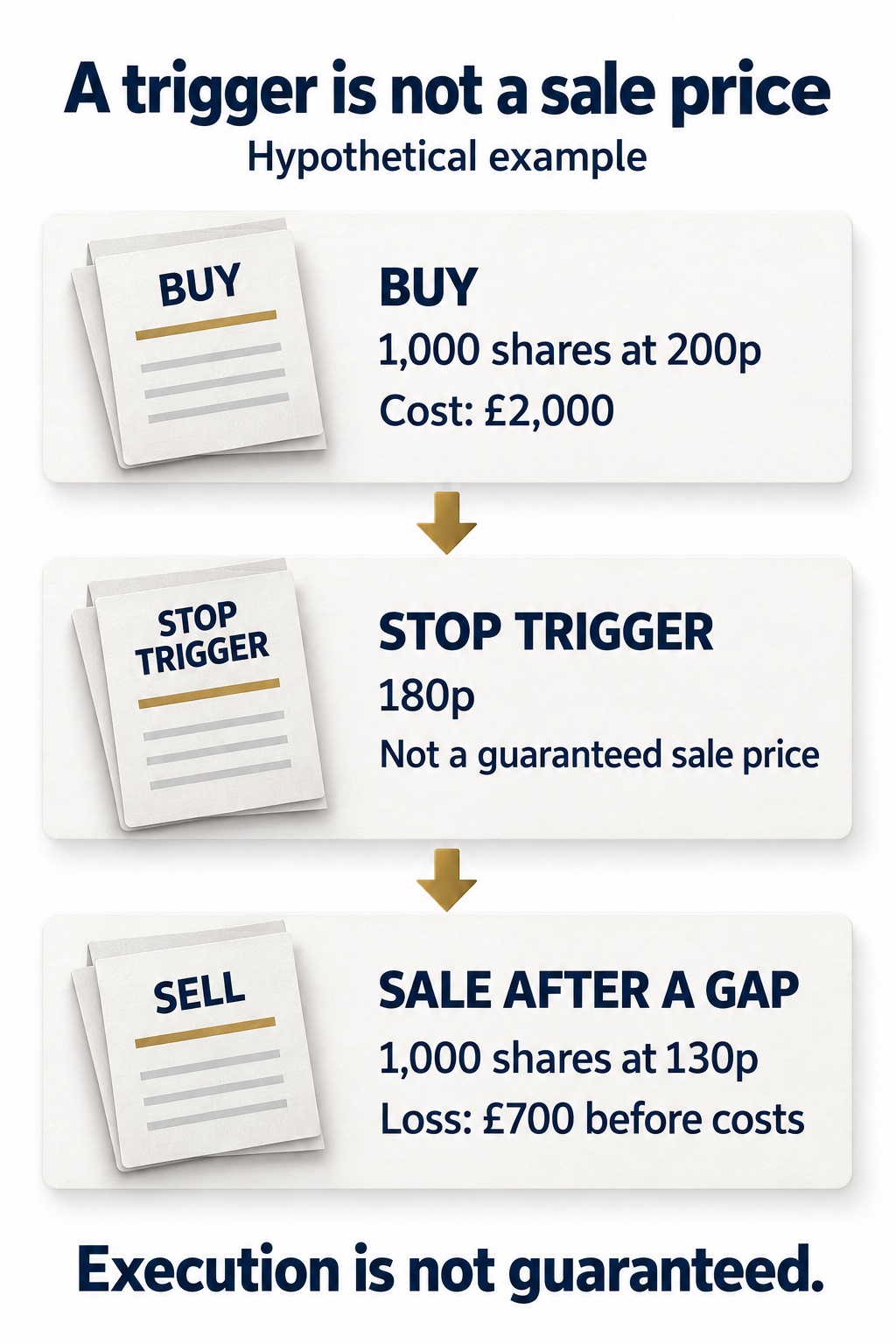
Suppose a fictional investor buys 1,000 shares at 200p for £2,000 and sets an ordinary stop-loss trigger at 180p. A sale at exactly 180p would lose £200 before costs, or 0.4% of a starting £50,000 portfolio. That is an assumption, not a promise.
If the price jumps down and the order instead executes at 130p, the sale raises £1,300 and the loss is £700: 35% of the holding, or 1.4% of that starting portfolio. Actual dealing charges and any applicable transaction taxes would affect the result. An order may also fail to execute.
Hargreaves Lansdown’s order terms explicitly warn about execution below the stop price, gaps and non-execution. That source describes its own service; check your broker’s trigger rules and order status. Our stop-loss guide explains why an ordinary stop and a stop-limit instruction have different trade-offs. Neither is a reason to treat a modelled loss as guaranteed.
Liquidity and shared risks can change the picture
Liquidity means how readily an investment can be bought or sold. The bid-offer spread is the difference between the buying and selling quotes. AJ Bell’s risk explanation warns that smaller-company shares can be more volatile with wider spreads, and that AIM shares can be harder to sell.
A displayed price is not a promise that the whole holding can be sold at that level. Consider the quote for the actual quantity, trading activity and the order’s conditions. A chart showing a neat closing price does not establish how easy it would be to exit a larger holding during a difficult market.
Several individually small positions can also share one large risk. Imagine five holdings, each worth 4% of the same starting portfolio, all exposed to one commodity. Their combined weight is 20%. If each falls by 50% while everything else is unchanged, the portfolio loses 10%. Different company names have not removed the shared exposure.
The FCA explains diversification across investments, sectors and markets. Spreading exposure can reduce dependence on one outcome; it cannot prevent all holdings falling together. “Core” and “satellite” are organisational labels, not guarantees that one group is safe or a prescription for particular weights.
Keep a short record and review what has changed
The useful part of a sizing plan is not a magic percentage. It is a record you can revisit before a price movement starts making the decision for you:
- Amount and weight: current holding value and the total portfolio used in the calculation.
- Downside scenarios: pound losses under several assumptions, including a total loss where relevant, without treating the scenarios as probabilities.
- Shared exposure: related holdings, sectors or funding risks, including overlap through funds.
- Exit limitations: spread, liquidity and what any order actually instructs the broker to do.
- Evidence to revisit: the facts supporting the investment case and what would challenge it.
Weights change even without trading. If the £2,000 holding doubles while the other £48,000 stays unchanged, it becomes £4,000 out of £52,000: about 7.7%, not 8%. A rising weight is a reason to reassess exposure, not an automatic instruction to sell. A falling price is not, by itself, a reason to add.
Keep money needed for near-term spending separate from a speculative investment decision. The FCA’s risk guidance asks investors to consider both when they need their money and whether they can absorb losses. Cash changes the portfolio’s exposure and available funds, but there is no single cash percentage that makes a small-cap portfolio suitable.
Before focusing on what a share might earn, work out what a difficult outcome would cost the whole portfolio. Then ask whether the assumptions survive a gap, a lack of buyers or several holdings falling together. Good arithmetic makes the exposure visible. It does not make the outcome certain.
Correction: An earlier example described £11,500 of a £50,000 portfolio as “just over 10%”. It is 23%. This update replaces that model allocation with explicit loss scenarios and removes blanket allocation recommendations.
This post is adapted from The Little Book of Small-Caps. Used with permission.
This article provides general financial education, not personal investment advice. Investments can fall as well as rise, and you may lose all the money invested in an individual company. Seek an authorised financial adviser’s help if you need advice about your circumstances.