Stablecoin uses explained: payments, costs and risks
Stablecoin uses explained for UK readers: compare payments, trading balances, conversion costs, dollar exposure and the risks beyond a fast token transfer.

A payment can arrive in a wallet before the recipient can spend it on rent. That gap explains both the appeal of stablecoins and the limits of their promise. To judge whether they are useful, follow the money all the way to something the recipient can actually use.
What are stablecoins used for?
Stablecoins are cryptoassets designed to track a reference value, often one US dollar. The target is called a peg; it is not a guarantee. Their uses include moving balances between crypto platforms, sending cross-border payments, accessing dollar-linked value, accepting customer payments and settling obligations between financial firms.
Those activities are not interchangeable. A trader receiving a token, a shop receiving ordinary currency and a bank settling with a payments network have different needs. A useful starting question is: who holds the token, and who eventually needs money in a bank account?
Nor does a large blockchain transfer total establish widespread shopping or remittance use. In an April 2026 speech on stablecoins, Bank for International Settlements (BIS) General Manager Pablo Hernández de Cos distinguished their substantial role inside crypto from more limited real-economy payment use. That is a dated assessment, not a live measure of adoption.
Trading balances and decentralised finance
A trader selling Bitcoin can receive a dollar-linked stablecoin instead of withdrawing pounds to a bank. The balance can then be used on a compatible platform without a fresh bank transfer. This changes the exposure: Bitcoin’s price risk is replaced by the stablecoin’s risks, the platform’s risks and, for someone measuring wealth in pounds, exchange-rate movements.
Stablecoins can also serve as collateral, meaning assets pledged to support borrowing, or move through decentralised finance services run by software contracts. A stable price target does not make a lending arrangement safe. The service adds its own rules, technical dependencies and possible losses. A return advertised on a stablecoin balance belongs to an additional arrangement, not to the word “stable”.
Staying inside crypto does not avoid UK tax rules. HMRC’s guidance includes exchanging one cryptoasset for another among disposals that may give rise to Capital Gains Tax. Spending stablecoins on goods or services can also count as a disposal for UK tax purposes, so keep records of their value in pounds even when the dollar peg holds. A disposal is a tax event to assess, not proof that tax is payable on every swap. Personal circumstances, gains, losses and applicable rules matter.
Cross-border payments: count the whole journey
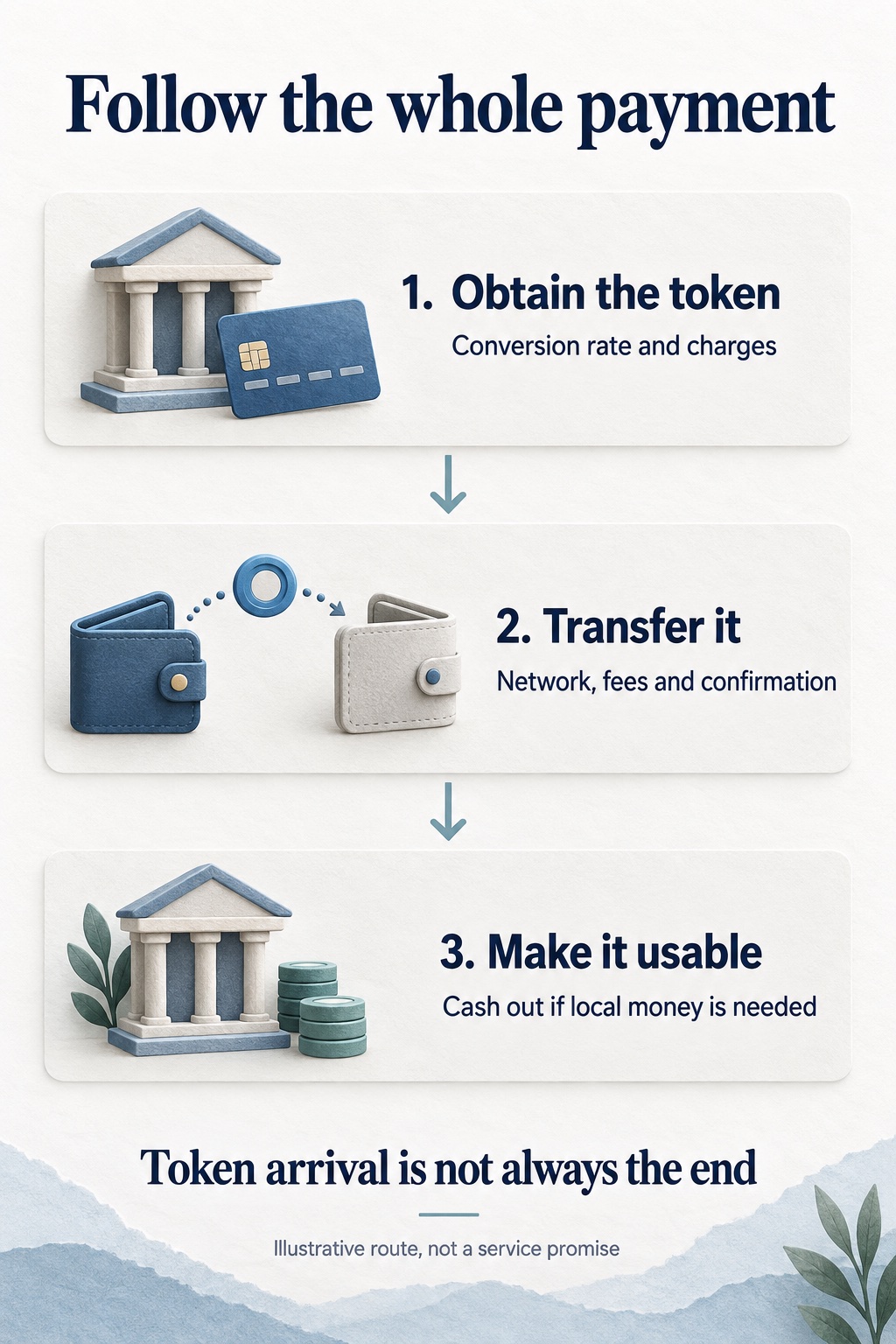
For an overseas supplier or family payment, the blockchain transfer may be only the middle step. A sender may first buy tokens with ordinary currency. The recipient may then need to sell them and withdraw local currency. These entry and exit services are often called on-ramps and off-ramps.
The BIS speech notes that blockchain transfers can operate around the clock, but warns that entry and exit costs can outweigh transfer savings, particularly for smaller payments. There is no sound universal claim that a stablecoin transfer is cheaper than a bank or specialist money-transfer service.
| Stage | What to check |
|---|---|
| Obtain the token | Purchase charge, exchange rate, identity checks and availability in the sender’s country. |
| Transfer it | Exact token and supported network, withdrawal and network charges, destination details and confirmation requirements. |
| Make it spendable | Recipient’s conversion rate, cash-out charges, withdrawal limits and time until usable local money arrives. |
Ask both services the same question: for the same amount paid by the sender, how much usable currency does the recipient get, and when? If the recipient already needs that exact token on that network, cashing out may not be necessary. If they need local currency today, a fast token arrival alone has not finished the job.
Payments you may not see: checkout and settlement
A customer can pay in a stablecoin without the merchant choosing to hold it. Stripe’s payment documentation, checked on 18 September 2026, describes customers paying with supported tokens while completed payments settle into the merchant’s Stripe balance in local currency. That balance is not the same as money already paid into a bank account.
As checked on 18 September 2026, the UK is not listed as a supported business location for this Stripe payment method. Customer availability does not establish merchant eligibility. Stripe also distinguishes refunds, returned to the original wallet as stablecoins, from chargeback-style disputes, which this payment method does not support. A payment method’s dispute feature is not a complete statement of a customer’s legal rights. These details describe Stripe’s product, not every stablecoin payment.
Behind a card payment, institutions may use tokens to settle what they owe one another. In its US settlement launch announcement, Visa reported that Cross River Bank and Lead Bank had begun settling with it in Circle’s USDC stablecoin on the Solana blockchain. Visa said this did not change the consumer card experience. It is an example of institutional use, not evidence that every Visa merchant receives stablecoins or that the service is available to every bank.
Dollar access is not sterling stability
Dollar-linked tokens can appeal to people seeking access to a foreign currency. They do not become insured savings accounts by serving that purpose. The token’s price, the route to redemption and the currency in which you pay your bills are separate questions.
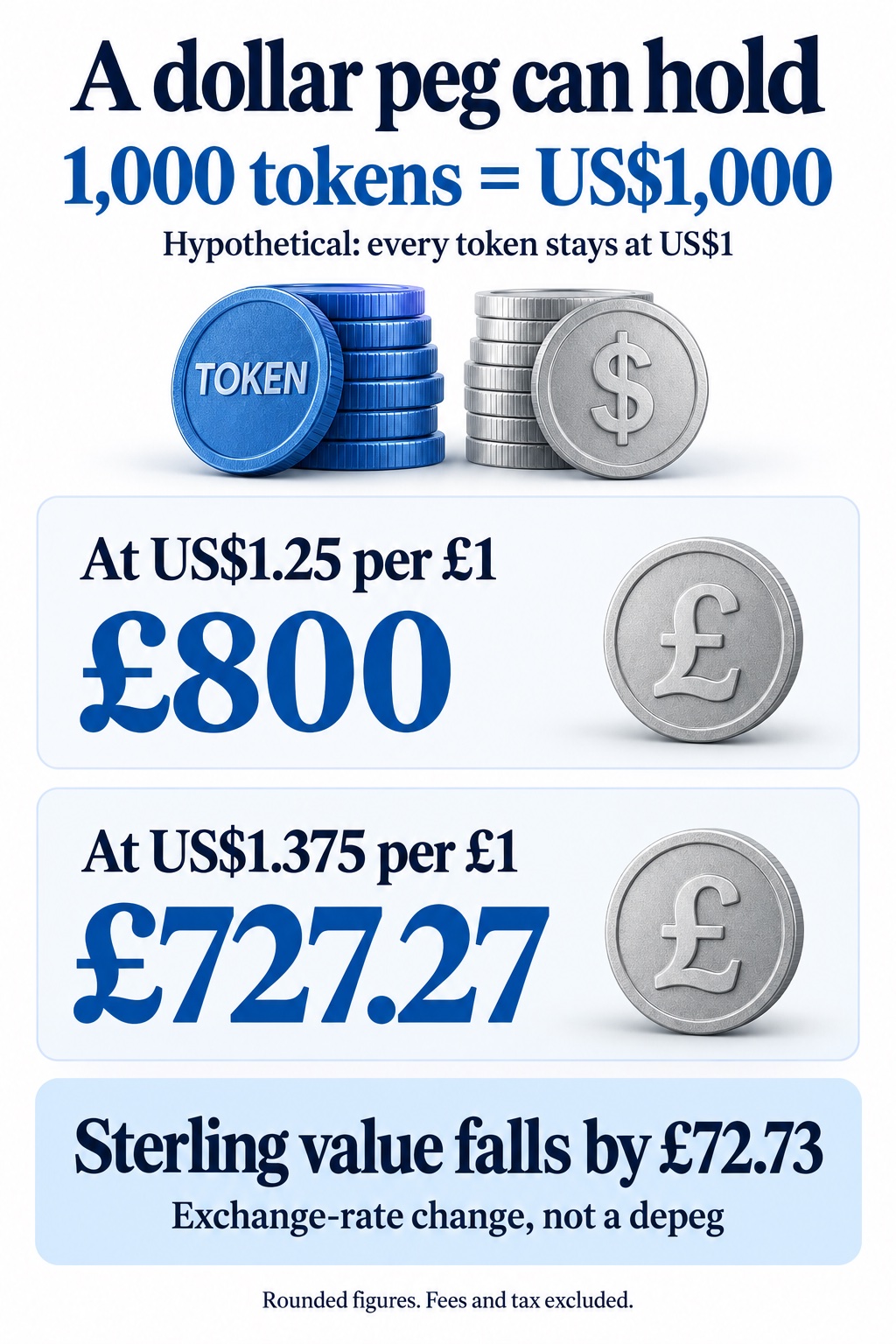
Consider a hypothetical holding of 1,000 tokens that remain worth exactly US$1 each. At US$1.25 per £1, they are worth £800. If sterling strengthens to US$1.375 per £1, the same US$1,000 is worth about £727.27. The sterling value has fallen by £72.73, or approximately 9.09%, even though the peg never broke. This excludes fees and tax and is not an exchange-rate forecast.
Our comparison of tokenised deposits, stablecoins and central bank digital currencies explains why similar-looking balances can represent different claims. For a specific token, check the actual issuer and terms rather than assuming that a dollar label means a dollar bank deposit.
Check the exit before judging the convenience
Redemption means returning a token to its issuer for the specified currency under its terms. Selling it to another market participant is different. Circle’s USDC terms for holders outside the European Economic Area (EEA) make direct redemption conditional on an eligible Circle Mint account and other requirements. They also warn that third-party market prices can differ from US$1. This is a product-specific example, not a universal redemption rule.
Those terms describe irreversible transfers, address-blocking powers and operational delays. A convenient interface does not remove those dependencies. The FCA’s consumer guidance warns that crypto users should be prepared to lose their money. Check the precise product and protections, not just the provider’s logo.
UK rules are changing. The FCA’s cryptoasset regime overview includes final stablecoin-issuance rules and says the full scope of regulated activities expands from 25 October 2027. That future framework is not a present guarantee for every token or service. Separately, HMRC’s stablecoin tax paper describes current treatment and possible reforms; discussion of an exemption is not an exemption already in force.
Before choosing a route, write down five things: what the recipient needs to receive, the total cost, when it becomes usable, who handles a failure, and what records you need for tax. Compare that with the ordinary payment alternative. If the benefit disappears once conversion and cash-out are included, there is no reason to prefer the more complicated route.
In plain English: stablecoins can make some transfers and financial operations easier. The useful test is not how quickly a token moves, but whether the complete journey solves a real problem at an acceptable cost and risk.
This article is for general financial education, not personal financial or tax advice. Cryptoassets, including stablecoins, can lose value; you could lose all the money involved. Check current rules and seek appropriately qualified advice for your circumstances.