What is Anthropic, and what does Google’s $40 billion bet mean for Claude users?
Google is backing Anthropic with up to $40 billion in equity and infrastructure. We explain the deal structure, what it means for Claude users, and how Claude compares to its rivals.

At a glance
- Developer
- Anthropic (US)
- Released
- Claude 1.0, March 2023; latest: Opus 4.7 and Haiku 4.5, April 2026
- What it is
- AI assistant, developer API, and enterprise platform
- Closest rivals
- ChatGPT (OpenAI), Gemini (Google), Microsoft Copilot
- Pricing
- API: $1 per million input tokens (Haiku 4.5) to $5 per million input tokens (Opus 4.7); claude.ai from no-cost tier to Pro at $20 per month
- Where to try it
- claude.ai
The deal works in two parts. Google is investing $10 billion immediately, at a $350 billion valuation for Anthropic. This matches the valuation attached to a funding round Anthropic closed in February 2026. A further $30 billion follows if Anthropic hits performance targets whose precise terms have not been publicly disclosed. Alongside the equity stake, Google is also providing computing infrastructure, adding to a separate agreement confirmed on 6 April 2026 in which Anthropic secured multiple gigawatts of next-generation TPU capacity from Google and Broadcom, with that capacity expected to come online from 2027.
It is worth pausing on the scale of that compute commitment. Training and running frontier AI models requires specialised chips running continuously at enormous scale. Anthropic’s chief financial officer, Krishna Rao, described the April compute arrangement as the company’s “most significant commitment to date.” The $40 billion investment sits on top of that infrastructure deal. Together, they represent a guarantee that Anthropic will have the raw processing power to keep Claude at the frontier of AI capability. For users, that translates into reliability and headroom for ongoing improvement.
To understand why the money matters, it helps to know what Anthropic is building. The company was founded in 2021 by Dario Amodei, Daniela Amodei, and several colleagues who had previously worked at OpenAI. Its stated focus is AI safety: building systems that behave predictably, can be corrected, and remain under meaningful human oversight. Claude is its main product, available as a chat interface at claude.ai, as a developer API, and through enterprise contracts. Claude Opus 4.7, the latest top-tier model released in April 2026, is described by Anthropic as a hybrid reasoning model combining standard response generation with extended computation on harder problems. At the other end of the range, Haiku 4.5 is optimised for speed and cost, suited to high-volume tasks where per-query price matters most.
The investor interest reflects commercial traction that has been building rapidly. According to Anthropic’s announcement of its expanded compute deal with Google and Broadcom on 6 April 2026, Anthropic now serves more than 300,000 business customers. Its large accounts, defined as customers generating more than $100,000 in annual run-rate revenue, grew nearly sevenfold in the past year. Claude Code, Anthropic’s AI coding assistant, has become particularly prominent in software development. A Bloomberg report published in April 2026 noted that Google identified its own weaker position in the AI coding market as an internal concern, with Claude Code regarded as the current benchmark for that use case.
Google is not the only cloud giant with stakes in Anthropic. Amazon committed $5 billion to Anthropic separately, with the option to put in as much as $20 billion more. Both the Google and Amazon deals use the same $350 billion valuation. That means Anthropic now has two of the world’s largest cloud providers as investors and infrastructure suppliers simultaneously, even though both compete directly with Anthropic through their own AI products.
Nothing on the market does exactly what Claude does at every price point, but GPT-5.5 from OpenAI handles the same categories of work and Gemini 2.5 Pro from Google offers a substantially lower API cost for organisations processing large volumes.
| Capability | Claude Opus 4.7 | GPT-5.5 (OpenAI) | Gemini 2.5 Pro (Google) |
|---|---|---|---|
| Context window | 1M tokens | 1M tokens | 1M tokens |
| Multimodal input | Text, images, code | Text, images, code | Text, images, audio, video |
| Agentic / long-horizon tasks | Yes (Claude Code, computer use) | Yes (Codex CLI) | Yes (Agent Platform) |
| API input price per million tokens | $5.00 | $5.00 | $1.25 |
| API output price per million tokens | $25.00 | $30.00 | $10.00 |
| Open weights available | No | No | No |
Pricing from official API pricing pages. Figures for Claude Opus 4.7 from anthropic.com; GPT-5.5 output price $30.00/M tokens verified at openai.com/api/pricing (April 2026); Gemini 2.5 Pro from ai.google.dev. As of April 2026.
The misconception worth naming
Most people reading about this deal assume Google is simply placing a bet against its own Gemini models. The reality is more layered. Google is a direct competitor to Anthropic in AI models, but it also supplies the infrastructure Anthropic runs on, and it now holds equity in Anthropic’s upside. This is a strategic hedge, not a concession. If Claude wins market share, Google earns on the investment and collects infrastructure revenue. If Gemini wins, Google keeps that business. The investment also gives Google access to Anthropic’s research direction and, in certain cases, to specific models. According to 9to5Google, Google is one of a small number of organisations with access to Anthropic’s Mythos model, which has not been made available to the general public. That kind of proximity to frontier research is part of what a $40 billion commitment buys.
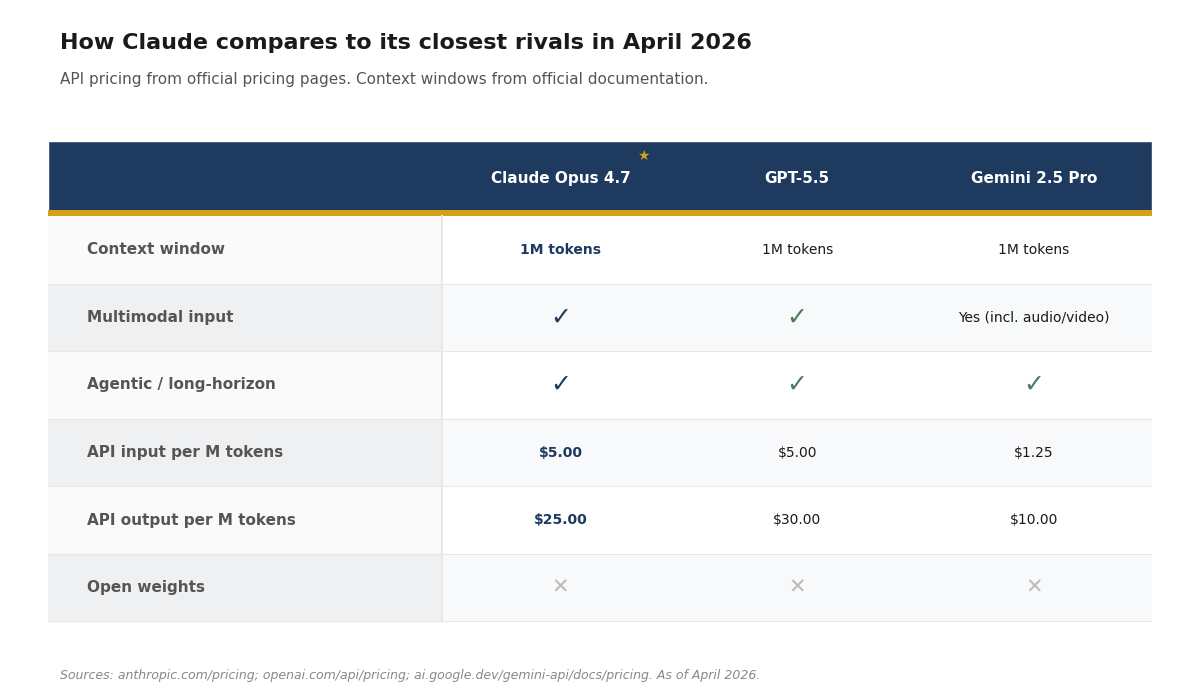
Source: official pricing pages (anthropic.com, openai.com, ai.google.dev). Feature comparison as of April 2026.
What this means for you
For individuals using claude.ai today, the announcement does not change the product this week. What it changes is the trajectory. The compute agreements mean Anthropic has secured the processing power to train and run more capable models through 2027 and beyond. The investment means it has the capital to do so without taking shortcuts on safety testing or deployment processes. Both of these matter for users who rely on Claude for consistent, accurate output over long periods.
For developers and businesses building on the Claude API, the commercial momentum Anthropic is reporting, 300,000 business customers and sevenfold growth in large accounts, signals that the API is unlikely to be deprecated or significantly disrupted in the near term. That is a practical consideration when choosing which AI provider to build on.
- The investment does not change Claude’s pricing or features immediately. API pricing for Opus 4.7 remains $5 per million input tokens and $25 per million output tokens, per the official Anthropic pricing page.
- New compute capacity is expected to come online from 2027, which is when users are most likely to see tangible improvements in model capability and availability driven by this infrastructure build-out.
- For cost-sensitive applications, Gemini 2.5 Pro remains significantly cheaper on a per-token basis. The choice between Claude and Gemini increasingly comes down to task type and integration preference rather than access to frontier capability.
Google is simultaneously one of Anthropic’s biggest competitors, its primary infrastructure supplier, and now one of its largest investors. It is an arrangement that would have seemed improbable three years ago. It reflects just how expensive frontier AI has become, and how much compute access shapes who can stay in the race.