5 September 2026: Greed outlasts the crypto pullback
Bitcoin is near $79,600 after the US jobs report, yet sentiment remains in Greed. The weekend test is whether the wider crypto market can stabilise.

Greed is surviving the pullback in crypto this Saturday morning, 5 September 2026. Bitcoin is near $79,600, below the $80,000 level it surrendered after Friday’s US jobs report, yet the main sentiment gauge still points to optimism. The useful question for the weekend is whether that confidence is supported by prices across the market, or simply reflects a strong run that has already happened.
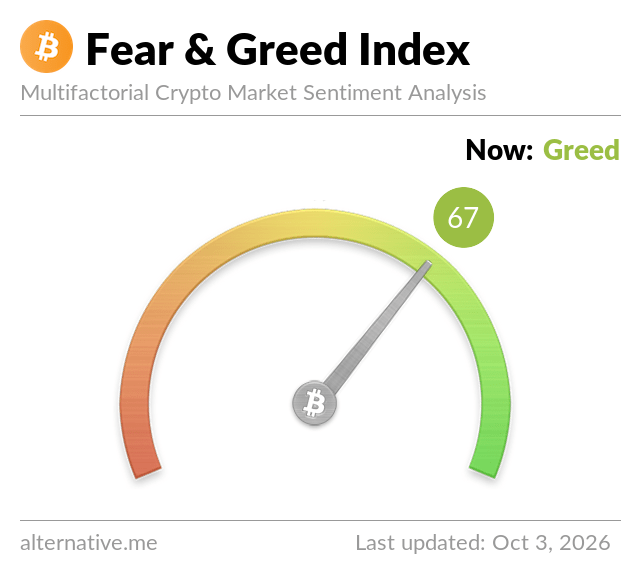
The market is softer, even though its mood has barely changed. At around 07:11 BST, CoinGecko’s market snapshot put total crypto capitalisation, the combined estimated value of circulating coins, at roughly $2.70 trillion, down 3.9% over 24 hours, with Bitcoin dominance, its share of that total, near 59.1%. Alternative.me’s Fear and Greed Index, a Bitcoin sentiment measure combining price behaviour, trading activity and other signals, reads 73 out of 100, in Greed territory, versus 74 yesterday; it describes sentiment, not where prices will go next.
The table summarises observed Bitcoin price changes from CoinGecko. Here, Neutral means a move of less than 0.5% either way, while Bullish and Bearish describe larger rises and falls. These are descriptive labels, not trading signals.
| Timeframe | Regime | What it means |
|---|---|---|
| 1 hour | Neutral | Price up about 0.10% over this period. |
| 4 hours | Neutral | Price up about 0.04% over this period. |
| Daily | Bearish | Price down about 1.80% over this period. |
| Weekly | Bullish | Price up about 2.50% over this period. |
| Monthly | Bullish | Price up about 23.10% over this period. |
Bitcoin is around $79,600, down 1.8% over the past 24 hours. It remains above the roughly $78,700 low in CoinGecko’s rolling daily range, but below the approximately $81,400 high. That puts the latest price between the extremes of an unsettled session, rather than at a fresh low. Over the last four hours, Bitcoin changed by less than 0.1%. That narrow movement sits inside a much wider daily range, which is why the timeframe attached to a price claim matters. A nearly flat overnight stretch is evidence that the immediate move has slowed, not proof that the selling is finished.
Friday’s US employment release reported 162,000 additional jobs in August and unemployment unchanged at 4.1%. Decrypt linked Bitcoin’s retreat below $80,000 to renewed expectations of a Federal Reserve rate increase after that report. The connection is plausible: stronger employment can reduce pressure on a central bank to support growth, leaving more room to tackle inflation.
That is a change in the economic backdrop, not a change to Bitcoin’s supply rules. Compared with the enthusiasm described in Friday morning’s rate relief briefing, the weekend starts with a more demanding test for buyers. Bitcoin has steadied below a widely watched round number, but has not recovered it.
Ethereum is near $2,450, down about 2.4% over 24 hours, a slightly larger decline than Bitcoin’s. Its daily low in the same CoinGecko snapshot is about $2,435, putting the price relatively close to the weaker end of its range. That matters because a recovery led only by Bitcoin would tell us less about confidence across crypto than one shared by the second largest asset.
The price data do not establish that investors are reacting to a particular Ethereum development. They do show Ethereum participating in the wider retreat after the jobs report, rather than providing an obvious counterweight. For readers, its relative weakness is a reason to distinguish a Bitcoin stabilisation from a broad market recovery.
XRP is around $1.40, down approximately 3.5%, making it the weakest of the four large assets reviewed here. Its sharper fall adds to the picture of uneven confidence beyond Bitcoin. The quote alone cannot tell us whether the cause is selling by existing holders, fewer willing buyers or both, so it would be a stretch to attach a token specific explanation without further evidence.
A low dollar price per token also says little about whether an asset is cheap. CoinGecko estimates XRP’s circulating market value at roughly $88 billion. Our guide to checking token supply and circulating value explains why the number of units matters alongside the price. Today’s useful comparison is the percentage move, not how many tokens one pound might buy.
Solana is around $102, down roughly 2.0%, broadly alongside Bitcoin’s daily decline. It is holding above its reported daily low near $100.40, but that does not make the psychologically neat $100 mark a guaranteed floor. Round numbers are useful reference points for describing the market; they cannot tell us how much buying interest will actually appear there.
Solana therefore adds a different detail to the same story: its decline is less severe than XRP’s, yet it is still participating in the retreat. Four falling assets do not represent every corner of crypto, but this sample offers little support for calling the morning a broad recovery.
The gap between optimistic sentiment and weaker prices is the weekend’s most useful lesson. Alternative.me’s methodology compares some inputs with longer historical windows, so a setback need not immediately erase an upbeat reading. The index and a 24 hour price change answer different questions. Treating one as a substitute for the other is how a reasonable description becomes a misleading forecast.
The jobs report also illustrates why encouraging economic news can unsettle speculative assets. If investors expect interest rates to stay higher, interest paying assets can become more competitive with holdings that depend on future resale value. That is a possible transmission mechanism, not proof that every seller had the same motive. The Federal Reserve still has to assess inflation and other evidence before making its decision.
The next checks are concrete: Bitcoin’s range, Ethereum’s participation and the coming inflation releases. A return above $80,000 would show Bitcoin recovering a level lost on Friday; a move below the observed $78,700 daily low would instead extend the latest decline. Neither outcome on its own establishes a lasting trend. Ethereum moving back towards $2,500 alongside Bitcoin would provide broader evidence of recovery than Bitcoin rising alone.
Beyond the weekend, the Bureau of Labor Statistics calendar lists producer price inflation for Thursday, 10 September, and consumer price inflation for Friday, 11 September, both at 13:30 BST. Hotter readings could reinforce concerns about tighter policy, while cooler readings could ease them. Those releases will give the rate debate new evidence. Until then, the practical distinction is between prices finding their footing and sentiment merely remaining cheerful.
Crypto Daily is Cristoniq’s daily guide to cryptocurrency markets, published every morning for informational purposes only. Nothing here is financial advice. Always do your own research before making any investment decisions.