7 August 2026: Bitcoin waits on payrolls as fear eases
Bitcoin hovered near $64,300 on Friday morning as traders waited for the US jobs report, while Fear and Greed rose to 29 and altcoins stayed selective.
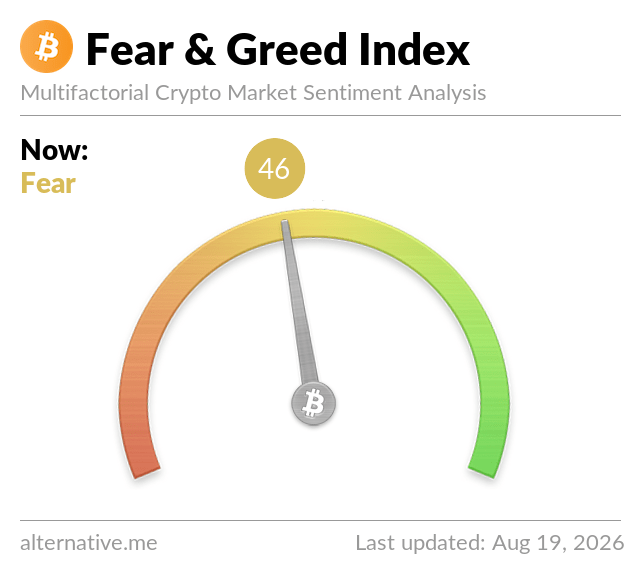
Friday, 7 August 2026 has opened with crypto markets doing a little less falling and a little more waiting. Bitcoin is trading around $64,348 after a small overnight dip, the Fear and Greed Index has lifted to 29 from 25 yesterday, and the biggest scheduled event on the calendar is the US employment report due later today, Friday 7 August 2026. That mix matters because prices are not collapsing, but confidence is still too fragile to call this a clean recovery.
The broad market tone is steadier than the sentiment reading, but still not convincing. CoinGecko’s global data puts total crypto market capitalisation at about $2.28 trillion, down roughly 0.7% over the past 24 hours, while trading volume is near $48.9 billion after falling about 12.4%. Bitcoin dominance stands at roughly 56.7%, which matters because it shows capital is still leaning toward the largest asset rather than spreading freely across the market. Alternative.me’s Fear and Greed Index is at 29 (Fear), up from 25 (Extreme Fear) yesterday, and that measure tracks volatility, momentum and participation rather than predicting the next move. Cristoniq’s explainer on the crypto Fear and Greed Index is useful context because today’s market still feels more cautious than the headline prices alone suggest.
| Timeframe | Regime | What it means |
|---|---|---|
| 1 hour | Neutral | Bitcoin is barely changed over the past hour, which suggests traders are holding risk steady while they wait for the next macro clue. |
| 4 hours | Bearish | The overnight drift has been mildly softer, so the market is still respecting sellers even without a sharp breakdown. |
| Daily | Bearish | Bitcoin is a little lower over 24 hours, which keeps the near-term picture cautious rather than clearly repaired. |
| Weekly | Neutral | The seven day view is almost flat, so the market has stabilised without yet proving a stronger trend. |
| Monthly | Bullish | Bitcoin is still higher over the past month, which means the bigger picture is firmer than the fearful mood alone would suggest. |
Bitcoin is still acting like the market’s anchor rather than its engine. At around $64,348 it is only down about 0.6% over 24 hours, and the one hour move is fractionally positive. That is a small detail, but it matters in a fearful market because stability often arrives before enthusiasm does. A market that is still processing uncertainty tends to stop breaking first, then start rebuilding later.
This is also where Bitcoin dominance becomes a practical signal for ordinary readers. With Bitcoin still controlling about 56.7% of total crypto market value, investors are showing a preference for the asset they trust most rather than chasing the rest of the complex. Readers who want the simpler backdrop can revisit Cristoniq’s guide to what Bitcoin is, because this morning’s move is less about a new Bitcoin story and more about whether the benchmark can keep the floor in place while traders wait for the next macro jolt.
So what: Bitcoin is doing enough to prevent panic, but not enough yet to declare the market repaired.
Ethereum, Solana, XRP, BNB and Dogecoin are mostly following the same cautious script, while Cardano is the clear outlier. Ethereum is near $1,901.82 and down about 0.3% over 24 hours. Solana is around $72.90 and lower by about 1.4%. XRP is trading near $1.024 after dropping roughly 2.6%, BNB is close to $587.21 and off about 1.4%, and Dogecoin is near $0.0693 with a decline of about 0.9%.
That spread matters because it says the market is not rushing into a broad risk-on move. Ethereum is almost flat over seven days and up about 8.3% over the month, which keeps it relevant as a confidence check beyond Bitcoin, and Cristoniq’s guide to what Ethereum is remains useful for readers who want that frame. XRP and Solana are both weaker over seven and 30 day windows, which helps explain why the market still feels selective rather than healthy. XRP in particular is worth watching through the lens of what XRP is and why it matters, because when that part of the market lags, it often tells you breadth is still fragile.
So what: most major coins are steady to softer, which fits a market that is holding its range rather than launching a new rally.
Cardano is the part of the tape that does not fit the rest of the morning quite so neatly. ADA is trading around $0.203, up about 7.2% over 24 hours, roughly 19.3% over seven days and about 18.0% over the month. That is much stronger than the broader market, and it is exactly the sort of move that can make a session look healthier than it really is if you only focus on the leaderboard.
The more sober reading is that one strong outlier is not the same thing as broad conviction returning. If Bitcoin were falling sharply and altcoins were still weak, Cardano would be a more meaningful counter-signal. This morning it looks more like selective risk taking inside a market that is still otherwise cautious. That is useful information, but it is not enough on its own to change the market-wide verdict.
So what: Cardano is showing there is still appetite for selective risk, but the rest of the market has not confirmed that message.
The real reason the market feels paused is that macro still matters more than crypto-specific noise this morning. The US Bureau of Labor Statistics schedule shows the Employment Situation report for July 2026 is due on Friday, 7 August 2026 at 8:30 a.m. Eastern Time. That release matters because it shapes expectations for interest rates, and crypto has spent much of the past year trading like a risk asset that reacts quickly when rate expectations move. A stronger labour print could revive the idea that policy will stay tighter for longer. A weaker one could lift hopes for easier financial conditions later on. Neither outcome guarantees a crypto move, but both help explain why traders are not rushing to make large calls before the data arrives.
That also helps explain why today’s background stories are best treated as context rather than catalysts. Institutional access still matters, which is why crypto ETFs remain part of the market’s long-term frame, and regulation still matters, which is why UK crypto rules stay relevant for readers thinking beyond the next session. But the immediate tape this morning looks like a waiting game. Bitcoin is stable enough to stop the mood worsening, Fear and Greed has improved without escaping Fear, and traders appear to be reserving judgement until they see the US jobs number.
So what: crypto is trading like a market in pause mode, with macro data still more important than any isolated token move.
The next checklist is fairly clear. First, Bitcoin needs to keep holding the low to mid $64,000s, because slipping decisively below that zone would make this morning’s stability look thin. Second, readers should watch whether Fear and Greed can hold above yesterday’s 25. A move from Extreme Fear to Fear is only a small improvement, but it is still an improvement. Third, breadth matters more than headlines: if Ethereum, Solana and XRP keep lagging while Cardano stays strong, the market remains selective rather than genuinely healthier. Fourth, once the US jobs report lands later today on Friday, 7 August 2026, the key question will be whether crypto treats it as a reason to extend the pause or finally pick a direction.
The practical morning read is calm but guarded. Bitcoin near $64,348 is not a disaster print. Fear and Greed at 29 is better than yesterday’s 25, but still far from confident. Cardano is providing one bright spot, while the rest of the large-cap market is mostly holding or easing. That leaves crypto in a familiar position for a data-heavy morning: stable enough to wait, not strong enough yet to trust.
Crypto Daily is Cristoniq’s daily guide to cryptocurrency markets, published every morning for informational purposes only. Nothing here is financial advice. Always do your own research before making any investment decisions.