7 June 2026: Bitcoin regains footing near $62K
Bitcoin recovered to around $61,700 on Sunday morning, but Extreme Fear and weak ETF demand still point to a market trying to steady itself, not rally.

Bitcoin is no longer falling as sharply as it was on Friday, but Sunday morning does not look like the start of a clean recovery. Prices have edged back towards $62,000, the most aggressive forced selling has cooled, and yet the Fear and Greed Index remains deep in Extreme Fear, which tells you confidence has not returned with the bounce.
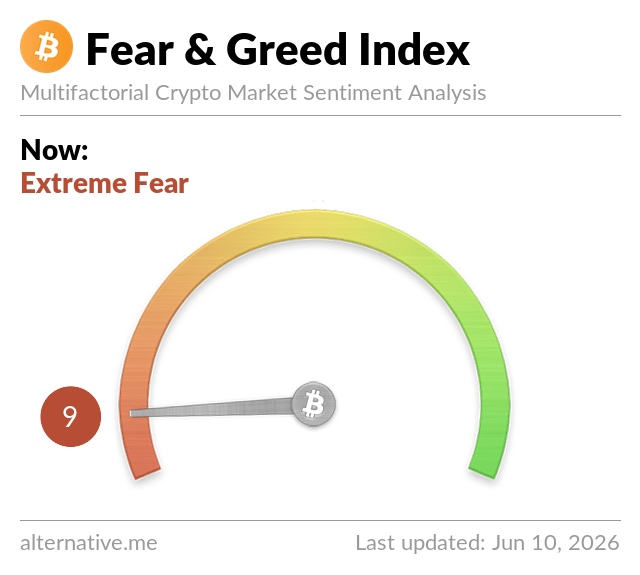
Crypto has started 7 June 2026 with a steadier tone, but not with much evidence that the market has repaired the damage from the previous two sessions. CoinGecko’s global data puts total market capitalisation at about $2.20 trillion, up roughly 1.4% over the past 24 hours, while Bitcoin dominance has held close to 56.0%. That dominance reading matters because it shows money is still clustering around the market’s largest asset rather than spreading confidently into the rest of the sector. Alternative.me’s Fear and Greed Index is still at 12, labelled Extreme Fear, and that gauge tracks mood through volatility, momentum and participation rather than predicting what happens next.
| Timeframe | Regime | What it means |
|---|---|---|
| 1 hour | Neutral | Bitcoin is almost flat over the last hour, which suggests the rebound has paused rather than rolled over again. |
| 4 hours | Neutral | The past four hours have been mostly sideways, which points to consolidation rather than a fresh break lower. |
| Daily | Neutral | Bitcoin is close to flat over 24 hours, which suggests a holding pattern near the lows. |
| Weekly | Bearish | Bitcoin remains well below last weekend’s level, so the broader weekly trend is still under pressure. |
| Monthly | Bearish | The one month picture is still weak, which means one steadier morning is not enough to say the market has reset. |
Bitcoin is trading around $61,700, up roughly 1.0% over the past 24 hours, and the small rebound matters mainly because it has pulled the market back above the line that broke so abruptly on Friday. Friday’s selloff pushed Bitcoin below $60,000 and left the market looking as if it might unravel into the weekend. That has not happened. Instead, buyers have managed to stabilise price action and keep Bitcoin in the low $60,000s. For readers who want a clearer explanation of why that matters, Cristoniq’s guide to Bitcoin dominance is useful here, because it explains why a defensive market often hides in Bitcoin first.
The important distinction is between stabilising and recovering. A move back above $61,000 is better than another break lower, but Bitcoin is still down more than 16% over the past seven days and more than 22% over the past month. That tells you the market has stopped panicking for now, not that it has rebuilt trust. Weekend trading can also exaggerate short term moves because liquidity is thinner, so one calmer morning should be read carefully rather than celebrated too quickly.
So what: Bitcoin has found its footing, but it has not yet proved that Friday’s drop was a final washout rather than a pause inside a weaker trend.
Altcoins are also firmer this morning, but the relative moves still describe a market that is trying to steady itself after heavy damage rather than one entering a new risk-on phase. Ethereum has recovered to around $1,600, up roughly 1.7% over 24 hours, while Solana is near $64 and up just over 2%. Dogecoin and Cardano have bounced more sharply, rising around 3.7% and 3.6% respectively, but those gains need context: Cardano is still down more than 32% over the past week, and Solana remains more than 22% lower over the same period. In other words, some of the weakest large-cap names are bouncing because they were hit hard, not because a stronger narrative has suddenly returned.
Ethereum remains especially important. When the second largest crypto asset underperforms for weeks and then can only manage a modest rebound while Bitcoin steadies, it suggests risk appetite across the market is still thin. Readers who want a plain English refresher on why exchange-traded funds matter here can revisit Cristoniq’s explainer on what crypto ETFs are, because fund flows have become one of the clearest bridges between broader investor sentiment and day-to-day crypto prices.
So what: altcoins have stopped spiralling, but they are still behaving like assets in a relief bounce, not like assets leading a fresh advance.
The broader catalyst still sits outside crypto itself, and the market has not fully shaken off the message from Friday’s United States payrolls report. The Bureau of Labor Statistics said on Friday, 5 June 2026 that nonfarm payrolls rose by 172,000 in May while unemployment held at 4.3%. That matters because it gave investors another reason to think the Federal Reserve may not get much help from a softer labour market just as inflation concerns remain in view. Crypto has spent much of 2026 trading like a high risk macro asset, so stronger economic data can work against it if traders think it keeps policy tighter for longer.
There is a second layer to the story. CoinDesk reported on 5 June that Bitcoin and ether ETFs finally snapped a long outflow streak, but only after large cumulative withdrawals had already drained confidence. That is the right way to read the latest bounce: a market can stop bleeding without suddenly becoming healthy. I also reviewed the latest UK regulatory headlines in the past 36 hours. The FCA’s 4 June 2026 action against Euro Exchange Securities UK Limited looks more like a payments supervision story than a broad crypto market catalyst, so it belongs in the background rather than at the centre of today’s piece.
So what: the weekend bounce is happening in a market still shaped by macro pressure and recent ETF withdrawals, not by any clear new crypto-specific catalyst.
What to watch next is fairly specific. First, Bitcoin needs to hold above $60,000 and ideally keep building above the $61,500 to $62,000 area, because slipping back through that range would suggest the weekend rebound lacked depth. Second, the market needs to show that Ethereum can defend the $1,500 area, since another decisive loss there would reinforce the idea that traders still want less crypto risk, not more. Third, the next major macro date is Wednesday, 10 June 2026, when the US Bureau of Labor Statistics is scheduled to release the Consumer Price Index for May at 8:30 a.m. Eastern Time. If that report keeps inflation worries elevated, crypto may struggle to do much more than trade sideways inside a bruised trend. Finally, the Fear and Greed reading itself matters: if prices can bounce while the index remains pinned near 12, it suggests the market is stabilising mechanically, not emotionally.
Crypto Daily is Cristoniq’s daily guide to cryptocurrency markets, published every morning for informational purposes only. Nothing here is financial advice. Always do your own research before making any investment decisions.