7 June 2026 PM: Bitcoin stalls below $62K
Bitcoin held near $61,800 on Sunday afternoon, but fading intraday momentum and unchanged Extreme Fear kept the crypto rebound tentative.

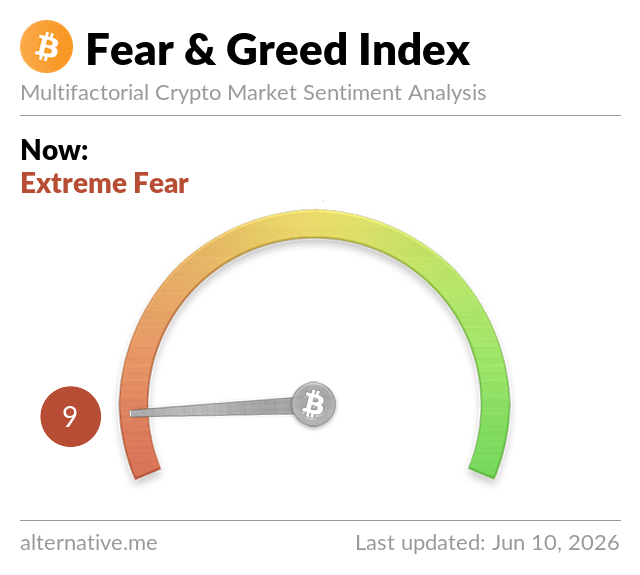
Bitcoin spent Sunday afternoon close to $62,000, but the rebound that looked reassuring at breakfast looked thinner by lunch. Prices were still above Friday’s panic lows, yet trading activity had cooled, the strongest hourly moves had turned lower again, and the Fear and Greed Index was still lodged in Extreme Fear.
Crypto is calmer than it was late on Friday, but this afternoon’s picture looks more like a market catching its breath than a market proving it is healthy again. CoinGecko’s global data put total crypto market capitalisation at about $2.23 trillion when this draft was prepared at 2026-06-07T13:04:42Z, while Bitcoin dominance held near 56.1%. That dominance reading matters because it shows traders are still clustering around the market’s largest asset instead of rotating confidently into the rest of the field. The same cautious tone shows up in aggregate activity: global 24 hour trading volume was about $79.1 billion, down roughly 51.5% from the previous day, which is a reminder that Sunday’s quieter tape may owe as much to thinner participation as to improving confidence. Alternative.me’s Fear and Greed Index remained at 12, labelled Extreme Fear, and readers who want the plain English version of what that measure tracks can revisit Cristoniq’s guide to the crypto Fear and Greed Index.
| Timeframe | Regime | What it means |
|---|---|---|
| 1 hour | Bearish | Bitcoin has slipped over the past hour, which suggests the morning bounce has lost urgency rather than accelerated. |
| 4 hours | Bearish | The past four hours have leaned lower, which tells you sellers are still fading rallies instead of chasing them upward. |
| Daily | Neutral | Bitcoin is still modestly higher over 24 hours, so the broader day has stabilised even though the intraday tone has softened. |
| Weekly | Bearish | The seven day picture remains weak, which means one steadier Sunday is not enough to repair the damage from the week. |
| Monthly | Bearish | The one month trend is still decisively lower, so confidence has not returned even with prices off Friday’s lows. |
Bitcoin is trading around $61,784, up roughly 1.3% over the past 24 hours, but the more useful point this afternoon is that the market has stopped bouncing harder as the day has gone on. Earlier stability helped pull Bitcoin away from Friday’s brief break below $60,000, and that alone matters because it reduces the sense that the weekend would turn into a straight continuation selloff. Even so, the intraday pattern has become less convincing. CoinGecko’s hourly data showed Bitcoin down about 1.3% over the previous hour and about 1.6% over four hours when this piece was assembled. In other words, price is still above the session lows, but buyers are no longer adding much urgency.
That matters for market structure as much as for headline price. Bitcoin is still down more than 16.3% over seven days and almost 23.0% over a month, which means a move back into the low $62,000s has not erased the larger loss of confidence. When the market is this bruised, the important question is not whether price has bounced at all, but whether it can hold above an area that traders now see as a test zone. Cristoniq’s explainer on Bitcoin dominance is helpful here, because it shows why defensive money often hides in Bitcoin first when the rest of crypto still looks vulnerable.
So what: Bitcoin has steadied, but by Sunday afternoon it is behaving more like an asset trying to defend a floor than one beginning a convincing recovery.
Altcoins are mostly green on a 24 hour basis, yet they are telling the same underlying story as Bitcoin rather than offering a separate risk-on signal. Ethereum was trading around $1,615, up roughly 2.9% over 24 hours, while Solana was near $64.2 and XRP close to $1.12. BNB also held firmer at about $587. On the surface those moves look constructive. In context, they look more like relief after a harsh week than like the start of fresh enthusiasm. Solana is still down more than 22% over seven days, Ethereum remains almost 30% lower over a month, and Cardano’s small 24 hour gain still leaves it down about 32.0% across the past week.
The pattern matters because the market’s leadership has not really changed. Ethereum’s bounce has been respectable, but not forceful enough to suggest that traders are racing back into second-layer risk. XRP and Solana are also doing what battered large caps often do after a sharp selloff: they recover some ground without changing the broader argument. That is also why exchange-traded fund flows still matter so much for sentiment. Cristoniq’s guide to what crypto ETFs are is worth revisiting, because it explains why even a modest return of institutional demand can change how the whole market trades.
So what: altcoins have stabilised with Bitcoin, but they are still reacting to a market trying to stop the damage, not leading a new leg higher.
The main catalyst still sits outside crypto itself, although one market-structure development is worth keeping in the background. Friday’s United States payrolls report remains the macro anchor for today’s session. The Bureau of Labor Statistics said on Friday, 5 June 2026 that nonfarm payrolls rose by 172,000 in May while unemployment held at 4.3%. That combination was not a disaster for risk assets, but it was firm enough to keep alive the idea that the Federal Reserve may not get much help from the labour market if inflation stays sticky. Crypto has spent much of 2026 trading like a high-risk macro asset, which is why stronger economic data can still cap enthusiasm even after the first wave of forced selling passes.
The market-structure story is Kalshi’s US launch of CFTC-regulated crypto perpetual futures. Kalshi said on 29 May 2026 that it would become the first company in US history to offer perpetuals under that framework, and the contracts went live in early June. That is genuinely notable for the shape of the American derivatives market, but it does not look like the reason Bitcoin is hovering around $62,000 on a quiet Sunday. If anything, today’s tape looks more defined by lighter weekend participation and by traders waiting to see whether Monday brings real follow-through.
So what: this afternoon’s market is still being driven more by macro after-effects and thin weekend liquidity than by any fresh crypto-specific catalyst.
What to watch next is fairly concrete. Bitcoin now needs to keep defending the $60,000 area and ideally rebuild above $62,000, because another decisive slip below that band would make Sunday’s stabilisation look temporary rather than durable. Ethereum’s ability to stay above $1,600 also matters, with the $1,500 area still the more important line if risk appetite fades again. The next major macro date is Wednesday, 10 June 2026, when the US Bureau of Labor Statistics is scheduled to release the May Consumer Price Index at 8:30 a.m. Eastern Time, and crypto has been sensitive to any number that changes the interest-rate debate. Finally, watch whether the Fear and Greed reading can move off 12 as US desks return on Monday, because a rebound that cannot improve sentiment usually tells you the market is stabilising mechanically, not convincingly.
Crypto Daily is Cristoniq’s afternoon update on cryptocurrency markets, published every weekday for informational purposes only. Nothing here is financial advice. Always do your own research before making any investment decisions.