Evening, 5 June 2026: Bitcoin nears $60K into Asia
Bitcoin closed near $60,000 after the May payrolls report, while Ethereum weakened further and crypto sentiment stayed at Extreme Fear.

Bitcoin is heading into the Asian open in a weaker position than it held at lunchtime, trading near $60,000 after the United States payrolls report failed to calm a market already stuck in Extreme Fear. The market had a macro event to react to, reacted badly enough to stay defensive, and now needs Asia to show whether $60,000 can act as support rather than just the next number down.
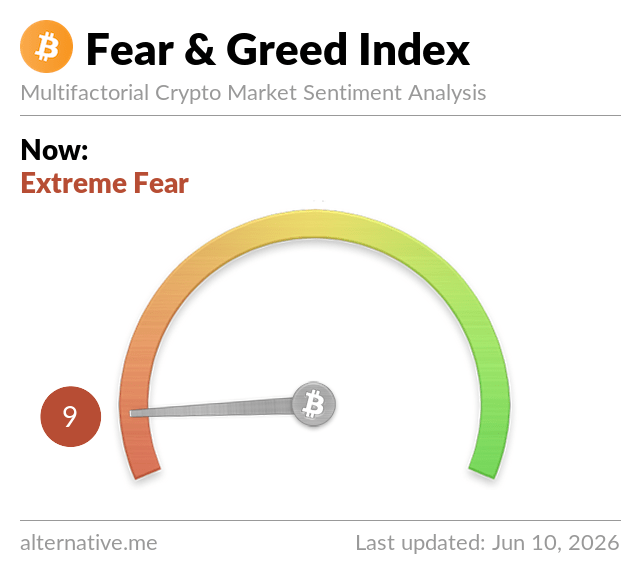
Crypto ended the UK day with lower prices and less room for optimism. CoinGecko’s global data puts total crypto market capitalisation at about $2.16 trillion, down roughly 6.0% over 24 hours, while Bitcoin dominance is near 55.8%. That mix matters because it shows money is leaving the asset class overall, yet investors are still holding relatively more of their exposure in Bitcoin than in smaller tokens. Alternative.me’s Fear and Greed Index remains at 12, in Extreme Fear territory, which is a sentiment measure built from volatility, momentum and participation rather than a prediction tool.
| Timeframe | Regime | What it means |
|---|---|---|
| 1 hour | Bearish | Bitcoin was still edging lower into the close, which suggests sellers remained more active than buyers even after the main payrolls reaction had passed. |
| 4 hours | Bearish | The market lost more ground after the PM update, so the late session told us confidence kept fading rather than rebuilding. |
| Daily | Bearish | Bitcoin is materially lower than it was 24 hours ago, which keeps the whole daily picture tilted toward defence. |
| Weekly | Bearish | The coin is still well below last week’s levels, so one calmer spell would not be enough to say the broader pressure has ended. |
| Monthly | Bearish | Bitcoin has fallen sharply from the higher levels seen earlier in the month, which means the market still needs a proper reset rather than a brief pause. |
Bitcoin is trading around $60,174, down about 5.9% over the past 24 hours, and the important change since Cristoniq’s PM post is that the market kept sliding after the payrolls number instead of using it as a stabiliser. At lunchtime, the PM update tracked Bitcoin near $62,024. By the evening snapshot it had dropped by roughly another $1,850, which is enough to make this a distinct close rather than a duplicate of the afternoon tone. The market had hours to digest the macro event, and the answer it produced was still caution.
The macro event itself was clear. The US Bureau of Labor Statistics said total nonfarm payroll employment increased by 172,000 in May and the unemployment rate was unchanged at 4.3% on Friday, 5 June 2026. That is not a crypto story in its own right, but crypto has spent much of this year trading like a sensitive risk asset, so a labour market release that can influence rate expectations matters for Bitcoin as much as it does for equities or bond yields. The fact that Bitcoin still drifted lower into the close suggests the report did not give traders enough confidence to rebuild exposure before the weekend.
There is also a useful structure point here. CoinGecko’s 24 hour volume reading is around $163 billion, which is still a high number, but the same dataset shows volume has fallen sharply from the prior burst of forced activity. That usually means the market is no longer in outright panic, yet it is also not showing the kind of committed buying that marks a clean turn. Readers who want the bigger framework can revisit Cristoniq’s explainer on Bitcoin dominance, because days like this show why investors retreat toward the market’s largest coin first.
Bitcoin’s role as the sector’s reference asset still matters. When it cannot hold a post event bounce, the rest of the market rarely finds a durable one on its own. Cristoniq’s guide to what Bitcoin is covers that central role, and this evening session is another practical example of it.
So what: the evening close is weaker than the PM baseline, which tells us the market used the payrolls window to reduce risk, not restore it.
Altcoins finished the day in an even less convincing position, which is usually the clearest sign that traders are still protecting capital before they go looking for opportunity. Ethereum is around $1,567.78, down roughly 11.6% over 24 hours, and that is a much steeper fall than Bitcoin’s. Solana is near $64.00, down about 7.9%, XRP is around $1.10 with a loss of roughly 6.8%, Binance Coin has slipped to about $567.78, and Dogecoin is near $0.081. Cardano remains one of the weakest large names at roughly $0.159, down close to 15.8% over the same period.
The evening comparison matters as much as the headline percentages. The PM post tracked Ethereum near $1,660.33. By the close it was nearly $100 lower, which means the afternoon weakness spread further into the wider market instead of stopping with Bitcoin. That is a very different signal from a broad based rebound, because in a healthier session the higher beta names usually recover faster than Bitcoin, not slower. Readers who want context on why that pattern matters may find Cristoniq’s explainers on what Ethereum is and crypto slippage useful, because falling liquidity often makes the gap between stronger and weaker assets more obvious.
There is no need to overstate this into a panic call. Prices can stabilise quickly in crypto, especially as weekend positioning changes. But an evening market close where Ethereum, Cardano and Dogecoin all look weaker than Bitcoin is still a sign that appetite for risk has not returned in any broad sense.
So what: the altcoin picture still looks like a market seeking shelter, not one preparing for a confident turn higher.
The main catalyst for today’s move was macro, but regulation remains part of the background and it still shapes how comfortable investors feel about crypto exposure. The payrolls release was the immediate scheduled event, yet the regulatory watch list has not gone away. The UK’s Financial Conduct Authority added Hyperliquid and hyperfoundation.org to its Warning List on 21 May 2026, saying the firm may be providing or promoting financial services or products without permission and that consumers should avoid dealing with it. That warning is not the reason Bitcoin fell this evening, and it should not be presented as one. It does, however, add to the sense that parts of the crypto trading ecosystem remain under scrutiny even when the daily price move is being driven by macro factors.
Short term price weakness can come from a jobs report, a rate repricing or simple risk reduction before a weekend. Confidence in the sector as a whole is shaped more slowly, through questions about access, regulation and counterparty trust. Cristoniq’s explainers on how crypto is regulated in the UK and what changes under the UK’s new crypto rules are useful background for that wider picture.
So what: macro set today’s direction, while regulatory pressure remains a live context rather than a direct evening trigger.
What to watch next is specific, and the first test will come quickly as Asia takes over. Bitcoin holding the $60,000 area matters immediately, because a clean break below it would leave the market closing the day without much evidence of a floor. Just above that, readers should watch whether the coin can recover back toward $61,000 and then the lower $62,000s, because that would be the first sign that the late session selling was running out of force. Ethereum also matters here: staying near $1,550 is one thing, but slipping decisively below that level would reinforce the view that traders still do not want broad exposure beyond Bitcoin. Beyond price alone, the next scheduled macro date worth keeping in view is Wednesday, 10 June 2026, when the US Consumer Price Index for May is due from the Bureau of Labor Statistics. For now, the simpler question is whether Asia treats this close as a chance to bargain hunt, or as a reason to stay defensive into the weekend.
Crypto Daily is Cristoniq’s evening market close summary for cryptocurrency, published nightly for informational purposes only. Nothing here is financial advice. Always do your own research before making any investment decisions.