3 June 2026: Bitcoin breaks lower as fear deepens
Bitcoin slid towards $67,000 on 3 June as extreme fear deepened, ETF withdrawals weighed on sentiment, and altcoins struggled to hold support.

Bitcoin has fallen back towards $67,086 and the rest of the market has followed it lower, with sentiment slipping deeper into Extreme Fear as traders digest another wave of ETF withdrawals and look ahead to the next round of US macro data.
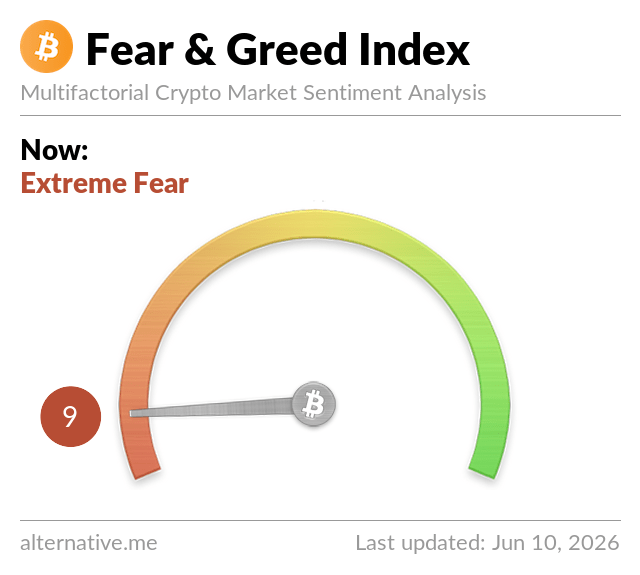
The total crypto market capitalisation is now around $2.40 trillion, down about 3.7% over the past day, while trading volume has risen to roughly $142 billion as selling picked up. Bitcoin dominance has climbed to 56.0%, which tells you capital is still retreating towards the biggest asset even as Bitcoin itself remains under pressure. The Fear and Greed Index has dropped to 11, from 23 a day earlier, and that measure of momentum, volatility and positioning now points to outright defensive behaviour rather than a balanced market.
| Timeframe | Regime | What it means |
|---|---|---|
| 1 hour | Neutral | The last hour bounced off the overnight low, but the move is too small to count as a clear reversal. |
| 4 hours | Neutral | Bitcoin has stabilised after the sharp drop, though it is still trading inside a fragile intraday range. |
| Daily | Bearish | The price remains well below where it traded a day ago, so the near term trend still points lower. |
| Weekly | Bearish | This week has been defined by persistent selling, which means buyers have not yet rebuilt control. |
| Monthly | Bearish | The broader trend is still weaker than it was a month ago, even after several brief rebounds. |
Bitcoin is trading at around $67,086, down roughly 5.0% over 24 hours, after briefly slipping towards the mid $65,000s during the overnight sell-off.
The scale of the move matters because it is not just a mild pullback inside an otherwise steady range. Bitcoin is now more than 11% lower over seven days, and the multi-timeframe picture remains bearish on the daily, weekly and monthly view even though the last hour has started to stabilise. In practical terms, that means buyers have managed a bounce, but they have not yet changed the broader direction of travel.
The more important explanation is the demand picture around the asset. CoinDesk reported on 2 June that US spot bitcoin ETFs had logged 11 straight sessions of net outflows, totalling about $3.45 billion according to SoSoValue data, and that streak has left the market more vulnerable to every fresh wave of selling. CoinDesk also reported that Strategy sold $2.5 million of bitcoin, a tiny amount relative to its holdings, but still enough to puncture the idea that one of the market’s biggest symbolic buyers would only ever add.
Bitcoin dominance rising towards 56.0% might sound constructive, but in this context it says more about altcoins losing ground than about investors growing confident. If you need a refresher on why that measure matters, Cristoniq has already explained what Bitcoin dominance tells you about the balance of risk inside crypto. The point this morning is simple: money is getting more selective, not more enthusiastic.
So what: Bitcoin is still the market’s centre of gravity, but it needs to reclaim the $70,000 area before traders can argue that this is anything more than a relief bounce inside a weaker trend.
Ethereum has dropped to about $1,868, down roughly 6.4% over 24 hours, and it is looking more fragile than Bitcoin.
That underperformance matters because Ethereum usually benefits when traders are comfortable taking more risk further down the curve. Instead, it has lost more than 9% over the past week and briefly traded below $1,850 overnight. In a market that is already nervous, weaker performance from Ethereum tends to confirm that investors are cutting exposure broadly rather than rotating neatly from Bitcoin into the next layer of large-cap crypto.
Solana is trading near $74.67, down about 7.0% on the day, which shows that high-beta names are still absorbing the heaviest pressure.
Solana’s seven-day decline is now above 10%, and that is consistent with a market that is pulling back from the faster-moving parts of the sector first. There is no need to invent a Solana-specific crisis to explain that weakness. When macro nerves rise and ETF demand for Bitcoin is fading, traders usually cut the more volatile positions before they reconsider the assets they see as core holdings.
Stellar is one of the few large tokens holding up relatively better, sitting around $0.224 and down roughly 3.3% over 24 hours, though it is still up sharply on the week.
That split matters. CoinDesk noted earlier this week that Stellar had surged after the 27 May announcement that DTCC plans to connect its tokenised securities platform to the Stellar network in the first half of 2027. The move lower this morning looks more like a cooling-off phase after that burst of enthusiasm than a full collapse in the story. Even so, the fact that XLM is still falling on a bad market day shows how difficult it is for idiosyncratic narratives to stay insulated when the wider tape turns defensive.
BNB has fallen to about $641, down roughly 6.6% on the day, and its slide is another sign that exchange-linked tokens are not getting any special protection.
There is no obvious Binance-specific headline driving that move this morning. Instead, BNB looks caught in the same broad de-risking move as the rest of the market, which is useful context for readers who still treat exchange tokens as if they trade on entirely separate logic. If you want the longer backdrop, Cristoniq has already broken down what BNB is and how it relates to Binance, but today’s message is more immediate: correlations rise when sentiment deteriorates.
The macro story is doing more work than any single crypto headline, and that is why today’s fear reading matters.
An Extreme Fear reading of 11 does not predict what happens next, but it does tell you how stretched sentiment has become. Traders are reacting to weaker ETF demand, heavier liquidations, and the sense that capital is finding more obvious homes elsewhere. CoinDesk’s market coverage on 2 June argued that part of the pressure is opportunity cost, with investors favouring AI-linked equities while crypto loses one of its easiest institutional support stories.
That does not mean crypto has lost every catalyst. It means the burden of proof has shifted back to buyers. Until ETF flows stabilise and the largest assets stop making fresh short-term lows, the market is likely to treat every rebound with suspicion. Readers looking for a broader explanation of trading frictions can also use Cristoniq’s guide to MEV in crypto, because it helps explain why stressed conditions often feel harsher in practice than a price chart alone suggests.
What to watch next is whether Bitcoin can recover $70,000, whether Ethereum can hold above $1,800, and what Friday 5 June’s US payrolls report does to the wider risk mood.
A move back above $70,000 would not fix the market on its own, but it would at least show that buyers are prepared to absorb the latest shock. If Bitcoin stays below that level and ETF flow data remains negative after the next US session closes, the pressure on altcoins is unlikely to ease. Ethereum’s $1,800 area matters for similar reasons: holding it would suggest selling is cooling, while another break lower would reinforce the message that investors are still reducing risk rather than repositioning for a rebound. Friday’s payrolls report matters because crypto has been trading more like a macro-sensitive risk asset than an isolated market. A hotter reading could push yields higher and keep this defensive tone intact.
Crypto Daily is Cristoniq’s daily guide to cryptocurrency markets, published every morning for informational purposes only. Nothing here is financial advice. Always do your own research before making any investment decisions.