19 May 2026 PM: Ethereum Slips to April Lows as Altcoins Lag
Ethereum slides to a six-week low while Bitcoin holds above $76,000. BTC dominance climbs to 58.2% as the CLARITY Act clears the Senate Banking Committee.

Ethereum drifted to its lowest level since early April this afternoon, underperforming Bitcoin for the fourth consecutive session as a cautious mood settled across crypto markets going into the latter part of the week. Bitcoin held near $76,600, roughly where it opened the morning, while altcoins absorbed the bulk of the selling as traders continued to favour relative safety within the asset class.
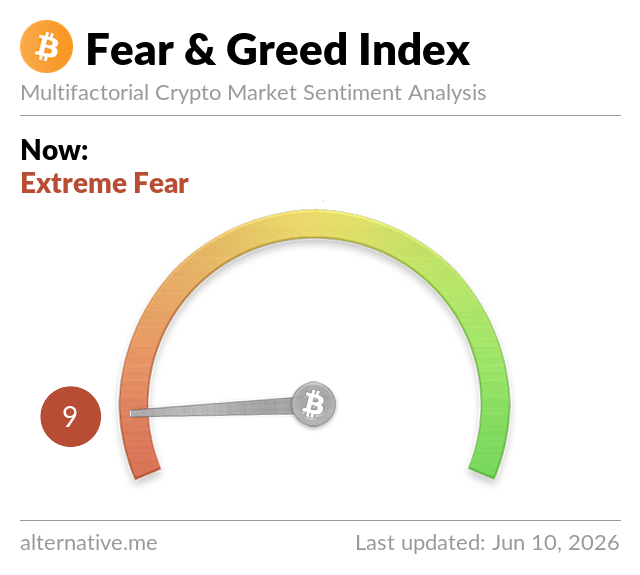
The total cryptocurrency market capitalisation sat at around $2.64 trillion as of this update, down approximately 0.5% over 24 hours. Bitcoin’s share of that total rose to 58.2%, one of the higher dominance readings in recent months, reflecting a pattern in place across the past week: capital is rotating toward Bitcoin relative to the rest of the market. The Bitcoin dominance reading has been climbing steadily as altcoins underperform, a dynamic that typically signals either a risk-off mood within crypto or a consolidation phase where retail interest is muted. The Fear and Greed Index, which combines signals from price momentum, trading volume, and social media activity to produce a single sentiment score from zero to one hundred, stood at 25, placing sentiment firmly in Extreme Fear territory for the second consecutive day.
| Timeframe | Regime | What it means |
|---|---|---|
| 1 hour | Neutral | BTC has oscillated between $76,600 and $77,200 all day with no clear direction |
| 4 hours | Neutral | A slight drift lower from morning highs but no sustained selling; structure is sideways |
| Daily | Bearish | Down around 1% over 24 hours with no recovery to yesterday’s close |
| Weekly | Bearish | BTC sat above $80,800 this time last week; it is now near $76,600, a decline of roughly 5% |
| Monthly | Bullish | BTC was near $75,200 a month ago; today’s level represents a gain of around 2.5% over 30 days |
Bitcoin was trading at around $76,600 (approximately £57,100) as of the early afternoon, essentially flat over the past four hours and down around 1% over 24 hours after an earlier peak near $77,200 failed to hold.
The session has been characterised by a narrow range rather than any decisive move. BTC has bounced from the $76,500 level repeatedly throughout the day, while the ceiling around $77,200 has equally resisted multiple tests. That kind of compression, where neither side can establish dominance, often precedes a resolution in one direction, though the timing remains unpredictable. Bitcoin’s ability to stay above $76,000 has been the stabilising factor for the broader market today, with altcoins absorbing the selling pressure that has not fully materialised in BTC itself.
Over the past week, Bitcoin has moved from around $80,800 to its current level, a decline of roughly 5%. The monthly picture is more constructive: Bitcoin sat near $75,200 a month ago, up around 2.5% over 30 days. There is no single macro catalyst at the current level; the market is watching and waiting rather than committing in either direction.
Ethereum fell to around $2,110 (approximately £1,570) this afternoon, its weakest level since early April, as the underperformance of altcoins relative to Bitcoin continued into a fourth consecutive session.
ETH has dropped roughly 3.7% over the past seven days, compared to Bitcoin’s 5% weekly decline. The difference matters less than the trend: Ethereum has not managed a meaningful intraday recovery in recent sessions and has seen its ratio to Bitcoin drift lower as BTC dominance climbs. The ETH/BTC dynamic is one of the cleaner signals of where investor confidence is sitting right now. When that ratio falls, it generally means that even crypto buyers are choosing the less volatile option.
The institutional backdrop for Ethereum is, on paper, more positive than the price suggests. CME Group and Nasdaq announced plans in mid-May to launch a Nasdaq CME Crypto Index futures contract on June 8, subject to regulatory clearance. That contract will track a basket weighted toward Bitcoin at around 77%, with Ethereum taking a 12.7% allocation. Regulated basket-style futures products broaden institutional access to the asset class beyond standalone BTC and ETH contracts, and the CME’s crypto average daily volume has already surged to 310,000 contracts in the first quarter of 2026 from 191,000 the year before, according to CME Group figures. Whether any of that translates into near-term price support for ETH is a different question, and one the afternoon session has so far answered with a shrug.
Solana traded at around $84.30 (approximately £62.90), down roughly 0.75% over 24 hours, a comparatively contained decline broadly in line with Bitcoin’s session rather than the steeper falls seen in ETH and XRP.
SOL has spent most of the past week in the $83 to $86 range, below its highs from earlier in 2026 but a relatively stable short-term floor. There is no network-specific catalyst behind today’s move; Solana is tracking broader macro sentiment. The modest decline is notable given that altcoins with smaller market caps have generally fared worse this week, suggesting the selling has not been uniformly distributed across the space.
XRP traded at around $1.37 (approximately £1.02), down about 1.5% over 24 hours, following the broader altcoin trend with no specific news catalyst to push it in either direction.
XRP’s regulatory position is worth noting given the week’s developments. The CLARITY Act, which would establish clearer rules about when a digital asset is classified as a security versus a commodity, has been central to the debate around XRP’s status since the SEC’s case against Ripple began in 2020. The Senate Banking Committee cleared the bill 15 to 9 on 14 May. That vote does not resolve XRP’s situation directly, but a fully implemented CLARITY Act would create the framework under which assets including XRP would receive clearer treatment. The market is not pricing any of this in today.
The most significant development for crypto this week did not come from price charts. On 14 May, the Senate Banking Committee voted 15 to 9 to advance the CLARITY Act to the full Senate floor, with two Democratic senators crossing party lines to support the bill alongside all committee Republicans. It was the most concrete sign yet that US cryptocurrency legislation has moved from aspiration to active legislative process.
The CLARITY Act would resolve a question that has created years of regulatory friction: whether a given digital asset is a security, overseen by the Securities and Exchange Commission, or a commodity, overseen by the Commodity Futures Trading Commission. The current state of affairs, where the same asset can be classified differently depending on which agency is pursuing enforcement, has made compliant operation difficult for exchanges and institutions alike. Opposition remains real: banking trade groups, unions, and law enforcement agencies have raised concerns about consumer protection gaps and anti-money-laundering provisions. Whether the bill clears the full Senate is not guaranteed, and the House passed a different version of the legislation last year, meaning reconciliation would be required. But for anyone working to understand how crypto markets cycle between fear and confidence, the current moment is instructive: sentiment sits at Extreme Fear even as the legislative backdrop is improving, which captures the gap between policy progress and the near-term pull of macro conditions.
Three things are worth watching over the next week. First, US inflation data due this week will matter for risk assets broadly. Crypto markets have proved sensitive to Consumer Price Index readings: a higher-than-expected figure would reinforce the case for the Federal Reserve to hold rates elevated, adding pressure to Bitcoin and altcoins alike; a softer print could support a recovery toward $78,000 to $80,000. Second, Bitcoin’s ability to hold above $76,000 is the key short-term level. It has bounced from near that point repeatedly over the past week; a confirmed daily close below it would bring the $74,000 to $75,000 area into view as the next meaningful support zone. Third, June 8 is CME Group’s target date for the launch of its Nasdaq CME Crypto Index futures. If that launch confirms on schedule, it will mark another expansion of regulated institutional access to the broader crypto market, covering a basket of assets beyond BTC and ETH through a single cash-settled contract for the first time.
Crypto Daily is Cristoniq’s afternoon update on cryptocurrency markets, published every weekday for informational purposes only. Nothing here is financial advice. Always do your own research before making any investment decisions.