18 May 2026: Ethereum and Solana Lead Monday Slide as Weekly Losses Build
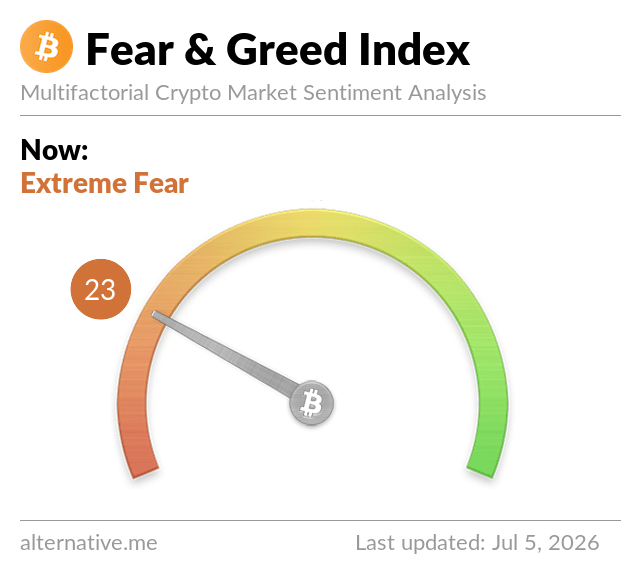
Crypto markets open the week in the red. Bitcoin slips to $77K, Ethereum loses another 3% overnight, and the Fear and Greed Index nudges to 28.

The weekend bounce did not last. Crypto markets open the new week in the red, with Bitcoin slipping back to around $77,000 and Ethereum giving up another 3% overnight. The Fear and Greed Index nudges up a single point to 28, still firmly in Fear territory, and the deeper story sits in the weekly numbers: Ethereum is down close to 9% over seven days, Solana has shed 10%, and Bitcoin has drifted back from the $81,000 highs it touched in mid-May.
Total crypto market capitalisation sits at roughly $2.65 trillion, down about 1.4% over the past 24 hours, with daily volumes near $66 billion. Bitcoin dominance has nudged up to 58.21%, which means the market is leaning more on Bitcoin and less on altcoins as risk appetite cools. The Fear and Greed Index, a sentiment gauge that blends volatility, trading volume, social media tone, surveys, and search trends into a single 0 to 100 score, reads 28 this morning, classed as Fear. That is a one-point move from yesterday’s 27, and the shift is barely visible. The market is not panicking, but it is not committing to risk either.
| Timeframe | Regime | What it means |
|---|---|---|
| 1 hour | Neutral | Bitcoin barely moved overnight, holding the $77,000 handle without a clear directional bias. |
| 4 hours | Neutral | Short-term consolidation around current levels, no breakout in either direction yet. |
| Daily | Bearish | Down 1.56% on the day with sellers in control of the immediate tape. |
| Weekly | Bearish | Down 4.58% over seven days, undoing most of early May’s gains and reversing the weekend recovery. |
| Monthly | Bearish | Back below where Bitcoin opened the month after the rejection from $81,000 last week. |
Bitcoin is changing hands at around $77,000 this morning, down approximately 1.6% over the past 24 hours and roughly 5% across the week.
In sterling terms that puts BTC near £57,800, well off the £61,000 zone it last visited in mid-May. The pullback follows a hotter than expected April US inflation reading that has pushed market expectations for Federal Reserve rate cuts further out, and a renewed bout of geopolitical strain around the Iran ceasefire over the weekend. Both of those signals lean negative for risk assets, and Bitcoin has not been the exception. What is notable is the calmness of the move. There has been no flush, no cascade of forced liquidations, just a steady drift lower on modest volume.
The takeaway: Bitcoin’s price action this morning looks more like fatigue than panic, but the $77,000 zone is doing real work as the first line of defence, and a clean break below it would change the conversation quickly.
Ethereum has slipped further than the rest of the majors, trading near $2,120 after losing another 3% overnight and close to 9% across the past week.
The move is striking because the long-running institutional story has been quietly positive for ETH. Regulatory filings earlier this year showed several trading desks rotating exposure from Bitcoin spot ETFs into Ethereum products, with Jane Street’s near-doubling of its iShares Ethereum Trust position the most visible example. That positioning has not yet shown up in price. Ethereum has underperformed Bitcoin for most of May, weighed down by softer activity on Layer 2 networks and by the same macro headwinds pressing on the rest of the complex.
The takeaway: institutional flows can build over months while sentiment moves day to day, and right now sentiment is winning. The $2,000 line is the one to watch, because losing it would be the first such break since March.
Solana has fared worst among the top names, down 2% on the day to around $85 and off by roughly 10% on the week.
Solana tends to amplify whatever Bitcoin is doing. When risk is on, SOL outruns the majors; when risk is off, it gives back more. The weekly chart is a reminder of that asymmetry. Network activity has not collapsed, and the chain continues to process strong transaction volumes, so the weakness here is sentiment and positioning rather than a fundamental shift. Memecoin volumes on Solana have cooled noticeably over the past fortnight, which removes a key support pillar that helped lift SOL through much of the spring.
The takeaway: Solana’s drawdown is consistent with how it behaves in a risk-off tape, but the speed of the weekly slide tells you traders are unwinding the higher-beta names first.
XRP is holding up better than most, trading at roughly $1.39 after a modest 1.8% pullback over 24 hours.
Relative strength is the story here. XRP is down on the day and the week, but its losses are softer than Ethereum’s or Solana’s, and that pattern has been consistent through May. The token has its own narrative around US regulatory clarity and cross-border settlement use cases, which has given it a degree of insulation from the wider crypto mood. None of that makes it immune to a deeper risk-off move, but it explains why XRP is currently behaving more like Bitcoin than like the rest of the altcoin pack.
The takeaway: XRP’s outperformance is not an upside story, it is a holding-pattern story, and that distinction matters when reading the market.
Tron has bucked the broader drift, edging up 0.65% over 24 hours to around 36 cents and posting a modest 2% gain on the week.
Tron is the only top-ten asset in green territory on both timeframes this morning. The chain’s role as a primary rail for stablecoin transfers, particularly USDT in emerging markets, gives TRX a use-case story that travels independently of broader crypto sentiment. When the rest of the market is selling off, Tron’s flows tend to keep moving because the underlying demand is transactional rather than speculative.
The takeaway: Tron is a useful tell for whether crypto weakness is broad-based or rotational. Today it is rotational.
The bigger picture worth flagging is the disconnect between institutional positioning and short-term sentiment. Filings from the start of this year have shown sophisticated trading desks accumulating Ethereum exposure on a multi-quarter timeframe, and several large asset managers have continued to build out Ether product line-ups. None of that flow is buying the daily price chart. It is buying a thesis about where the next leg of the institutional cycle will be concentrated, and that thesis can sit comfortably alongside a tough week or month in spot prices.
What that means for readers is straightforward. The daily tape tells you about retail mood, macro signals, and short-term positioning. The institutional tape moves on a different clock. When the two are aligned, moves are clean and trends extend. When they diverge, as they appear to be doing now in Ethereum, prices can drift even when underlying flows are constructive, and any eventual recovery tends to come in a single sharp move rather than a gradual climb. Yesterday’s evening recap covered exactly that pattern playing out in Sunday’s session, with a brief bid in altcoins fading into the US close.
Looking forward, the first level worth watching is $75,000 on Bitcoin. A clean break below would put early-May lows back in play and would likely force a fresh round of selling across leveraged positions. On the upside, $80,000 has become immediate resistance after the rejection from $81,000 last week, and a daily close back above that mark would signal that the weekly drift has paused. For Ethereum, $2,000 is the psychological line that has not given way since March, and losing it would matter not only for ETH holders but for the broader altcoin complex, which tends to follow Ethereum’s lead. The week’s macro calendar is light at the start but builds into Wednesday’s release of the latest Federal Reserve meeting minutes, where any hint of a hawkish tilt on inflation would extend the current weakness, and conversely any language suggesting that rate cuts are still on the table this year would give risk assets a chance to find a floor.
Crypto Daily is Cristoniq’s daily guide to cryptocurrency markets, published every morning for informational purposes only. Nothing here is financial advice. Always do your own research before making any investment decisions.