13 May 2026: Bitcoin Holds Near $80,000 as JPMorgan Files for On-Chain Money Market Fund
Bitcoin holds near $80,000 as Trump's China summit opens and JPMorgan files for an on-chain money market fund, pointing to growing institutional interest.

Bitcoin is trading near $80,000 this Wednesday afternoon, essentially flat as markets absorb a fresh CPI reading and await signals from President Trump’s summit with Chinese officials. The dominant story of the session is not price action but institutional intent: JPMorgan has filed with the SEC for an on-chain money market fund, a development that reflects how seriously Wall Street is now treating blockchain as financial infrastructure rather than as a speculative curiosity.
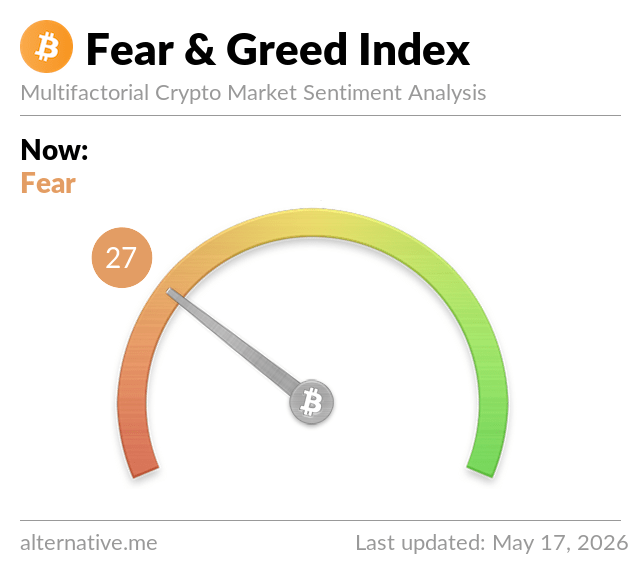
The total crypto market cap sits at approximately $2.77 trillion, barely changed over the past 24 hours. Bitcoin’s share of that total has risen to 58.2%, suggesting capital continues to consolidate around the market’s largest asset. The Fear and Greed Index, which aggregates price momentum, trading volume, social media signals, and market volatility into a single sentiment score, reads 42 today (Fear territory), a step back from yesterday’s Neutral reading of 49, meaning sentiment has edged cautious even as prices held steady.
| Timeframe | Regime | What it means |
|---|---|---|
| 1 hour | Neutral | Bitcoin recovered from the session low of around $79,880 but has not established a clear direction; price is oscillating without a defined trend. |
| 4 hours | Neutral | Range-bound between roughly $79,900 and $81,300. Neither buyers nor sellers have asserted control over the medium-term intraday picture. |
| Daily | Neutral | Down less than half a percent on the day. The daily close is pointing to a consolidation session rather than a directional move. |
| Weekly | Bearish | Bitcoin is down roughly 2.2% over the past seven days, reflecting the pullback from last week’s highs and continued caution from macro data. |
| Monthly | Bullish | Up approximately 13.7% over 30 days. The longer-term recovery from April lows remains intact even as short-term momentum has softened. |
Bitcoin is trading at approximately $80,475 this afternoon (around £59,600 in sterling terms), down less than half a percent over the past 24 hours, with the day’s range running from around $79,880 to $81,263. The flat price action comes against a meaningful macro backdrop. A Consumer Price Index report earlier this week in the United States showed energy costs rising, partly reflecting the ongoing conflict in the Middle East, and that data has kept investors cautious across equity markets and crypto alike. President Trump’s summit with Chinese officials, which opened today, is being watched closely by traders hoping that improved trade relations could lift risk sentiment, and a constructive outcome could provide the catalyst the market has been waiting for. The most important technical level is $82,000: Bitcoin has tested it several times this week without breaking through convincingly. Until it does, the path of least resistance is sideways.
Ethereum is trading at approximately $2,302, up around 0.74% over the past 24 hours, making it one of the few larger-cap assets in positive territory this afternoon. That modest recovery follows two days of notable underperformance. CoinDesk reported this week that the ETH/BTC ratio, which tracks how much Bitcoin one Ether can buy, has fallen to a 10-month low. This ratio is widely used as a barometer of altcoin appetite: when it falls, it generally reflects either Bitcoin strength, Ethereum-specific weakness, or both. Today’s bounce does not reverse that trend in any meaningful way. The support level around $2,275 held through Tuesday’s selling, and the immediate question is whether it holds again if selling pressure returns. Today’s move looks more like a technical recovery than a shift in underlying momentum.
BNB is trading at around $678, up approximately 2.3% over the past 24 hours, extending the gains it posted during the morning session. This marks a second consecutive day of outperformance for the Binance-linked token in an otherwise flat market. No single catalyst has been attributed to the move, and trading volumes remain contained at around $1.3 billion over the past 24 hours. BNB’s steady drift higher in a flat market typically reflects underlying demand from within the Binance ecosystem rather than speculative activity driven by news.
Dogecoin has climbed approximately 3.2% over the past 24 hours, trading at around $0.113, making it the strongest performer in percentage terms among the widely tracked coins today. The move does not appear linked to a specific news event. Dogecoin’s price has historically been driven more by social media activity and speculative positioning than by fundamental developments, and volume at roughly $1.5 billion is elevated relative to recent averages. In an otherwise flat session, the move is a data point rather than a narrative.
The development in crypto markets this week that deserves the most sustained attention has nothing to do with any coin’s price. JPMorgan filed a registration statement with the US Securities and Exchange Commission on Tuesday for the JPMorgan OnChain Liquidity-Token Money Market Fund, set to trade under the ticker JLTXX. The filing marks one of the most direct moves yet by a major US bank to bring a mainstream financial product onto blockchain infrastructure from the outset.
Money market funds are among the most widely used financial instruments in the world, holding short-duration assets for institutional and retail investors who want liquidity without meaningful risk. Tokenising such a fund, meaning placing its shares onto a blockchain, offers several theoretical advantages: settlement becomes faster, access can be extended to smaller investors, and the tokenised shares can potentially be used as collateral within wider digital finance systems. For a clear explanation of how tokenisation works and why it has drawn growing interest from financial institutions, the Cristoniq explainer on what tokenisation means and why banks are moving into it covers the underlying mechanics.
What makes the JPMorgan filing significant is not simply that a large bank has expressed interest in blockchain technology. It is that the product is designed to operate on-chain as its primary architecture, rather than being a traditional fund with a blockchain wrapper added afterwards. Filing publicly with the SEC signals that JPMorgan believes the regulatory framework is now stable enough to bring this kind of product to market. That judgement, coming from one of the most cautious and compliance-focused institutions in global finance, carries real weight. It connects directly to the broader theme shaping the industry in 2026: the question is no longer whether traditional finance will engage with blockchain, but how quickly and in what form. The Cristoniq guide to real-world assets in crypto covers how this institutional shift is playing out across different asset classes.
The immediate event to watch is the US Senate Banking Committee hearing on the Digital Asset Market Clarity Act, scheduled for tomorrow, 14 May. The Act aims to clarify the regulatory boundary between securities and commodities in the digital asset space, a distinction that has created sustained legal uncertainty for exchanges, issuers, and investors alike. Committee hearings of this kind can shift sentiment quickly, particularly if witnesses and committee members signal genuine support for clearer definitions. A constructive session would likely give a modest lift to assets in the institutional layer, including Bitcoin, Ethereum, and tokenised instruments. A combative or inconclusive outcome would add to the caution already visible in the Fear and Greed reading.
Also notable on Thursday is the formal end of Jerome Powell’s tenure as Chair of the Federal Reserve. Markets have been watching the transition carefully, because any signal of a shift in monetary policy tone from incoming leadership would feed directly into rate expectations. For crypto, which has grown more sensitive to interest rate movements as institutional participation has increased, a dovish signal from the incoming Chair would be a meaningful positive catalyst. A more hawkish tone would maintain the current headwinds on risk assets including Bitcoin.
On a technical basis, Bitcoin’s range to track is $79,800 on the downside and $82,000 on the upside. A sustained break below $79,800 would likely attract selling from short-term holders who entered during the recent recovery. A clear move above $82,000 would open the path toward a retest of the $84,000 to $85,000 zone that capped the market earlier this month. Between those levels, the path of least resistance is sideways, and the two scheduled macro events this week are the most likely catalysts for a break in either direction.
Crypto Daily is Cristoniq’s afternoon update on cryptocurrency markets, published every weekday for informational purposes only. Nothing here is financial advice. Always do your own research before making any investment decisions.