Crypto Daily 15 Apr: Goldman Joins the Bitcoin ETF Race
Bitcoin pulls back from a two-month high of $75,829 as peace-talk optimism fades, while Goldman Sachs files for its first Bitcoin income ETF.
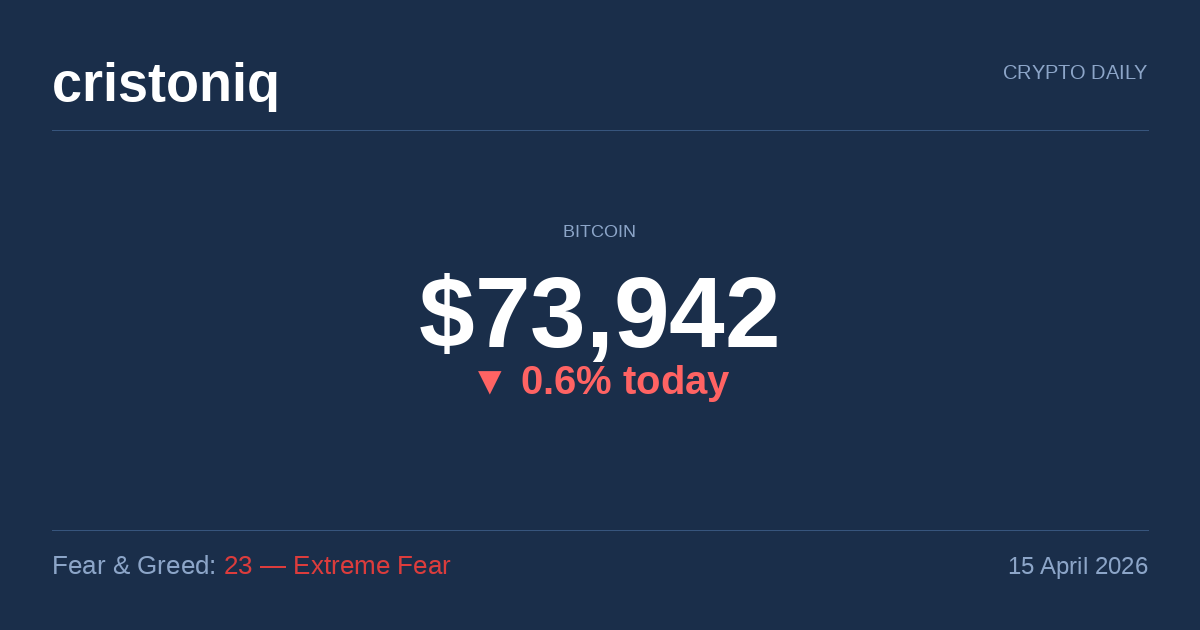
Bitcoin gave back some of yesterday’s gains overnight, pulling back from a two-month high of $75,829 as peace-talk optimism met a familiar ceiling around the $74,000 mark. The fade does not erase the bigger story: markets responded sharply to any hint of geopolitical de-escalation, and Goldman Sachs chose the same day to file for a Bitcoin income ETF, a sign that Wall Street’s interest in crypto exposure is expanding well beyond simple spot funds.
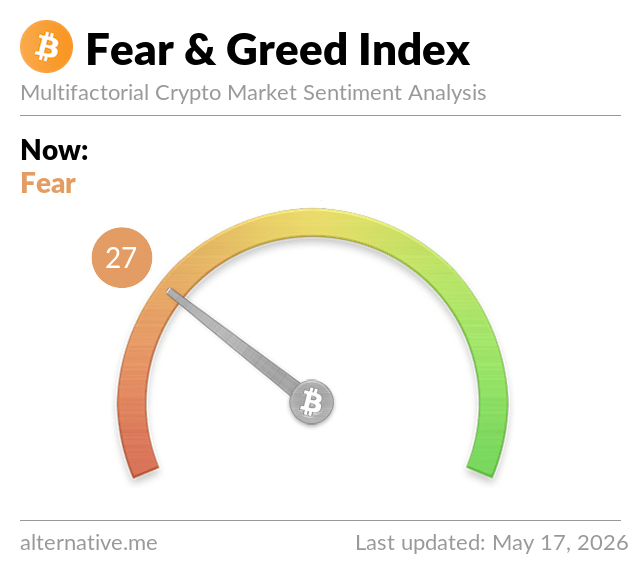
The total cryptocurrency market sits at $2.584 trillion on 15 April 2026, down 0.46% over the past 24 hours. Bitcoin accounts for 57.28% of that figure, its dominance edging higher as altcoins shed their bounce gains faster than BTC. The Fear and Greed Index, a composite score measuring crowd sentiment across price momentum, social media, and volatility, reads 23 today. That puts it firmly in Extreme Fear territory, where it has spent most of the past several weeks. A reading this low normally reflects a market that lacks conviction rather than one in outright panic, and Wednesday’s price action fits that description well.
Bitcoin is trading at $73,942 (roughly £59,200 at current exchange rates), down 0.56% over the past 24 hours after touching $75,829 yesterday. That high was the best BTC had seen since early February, driven by a wave of risk appetite as reports emerged of progress in US-Iran peace negotiations. The rally cleared a significant number of short positions along the way: approximately $135 million in futures liquidations were recorded across major exchanges in the 24-hour window. The pullback since has been measured rather than panicked, but the $75,000 level, close to BTC’s 100-day moving average, is proving to be genuine resistance. The support zone below sits in the $68,900 to $70,000 range, a band that held through the worst of early April’s selling. BTC is building positive momentum on the shorter-term charts, with the relative strength index around 63, elevated but not yet in overbought territory. The coin remains 41% below its all-time high of $126,080 set in October 2025. Until a daily candle closes convincingly above $75,000, this is a bounce in a bearish longer-term trend.
Ethereum is at $2,318.48, down 1.96% on the day after briefly touching $2,401.35 yesterday. ETH moves further in both directions than Bitcoin in most market conditions, and that pattern is playing out again: it gained more than 7% on 14 April and is giving it back faster today. The coin remains 53% below its August 2025 all-time high of $4,946. On the development side, the Ethereum Foundation announced a $1 million audit subsidy programme on 14 April to lower security review costs for mainnet builders. The scheme covers up to 30% of audit fees and connects teams with more than 20 firms including Certora, Spearbit and Zellic. A second protocol milestone is approaching: the Glamsterdam network upgrade devnet is expected to deploy shortly. Neither development has been enough to hold price gains today, but both represent continued investment in Ethereum’s long-term foundations.
XRP is trading at $1.36, down 0.63% on the day and nearly 1% on the week. The timing is striking, because the XRP Ledger made a significant technical step forward on 14 April: it integrated Boundless, a zero-knowledge proving network, enabling private transaction verification on its public blockchain for the first time. Zero-knowledge proofs allow a transaction to be confirmed as valid and compliant without revealing the amount, sender, or receiver to anyone reading the ledger. That fills a gap that has long made transparent blockchains awkward for large institutional payments and treasury management. Institutional names including SBI Holdings, Archax in the UK, and Guggenheim Treasury Services are already active on the network. The market’s response has been muted, suggesting the upgrade was anticipated. XRP is 62.7% below its July 2025 all-time high of $3.65.
Solana has had the hardest day among the major coins, dropping 3.04% to $83.17. The Solana Summit wrapped up on 13 April without delivering a market-moving catalyst, and the subsequent price action has the look of classic sell-the-news behaviour. The irony is that Solana’s underlying network remains genuinely active: Q1 2026 total economic activity on the chain reached $1.1 trillion, driven by DeFi protocols, staking, and persistent meme coin trading volumes. Spot Solana ETFs from Bitwise and Fidelity have collectively surpassed $1 billion in assets under management since their late 2025 launch. None of that has cushioned the price today. SOL is shedding more than five times as much as BTC while Bitcoin dominance edges quietly higher. It remains 71.6% below its all-time high of $293.31 from January 2025.
The development worth slowing down on today is Goldman Sachs’ move into Bitcoin ETF products. The bank filed a preliminary prospectus on 14 April for a Bitcoin Premium Income ETF using a covered call strategy. The fund would buy exchange-traded products that hold Bitcoin and sell call options against a portion of that exposure, generating income from the option premiums paid by buyers of those options. That income is distributed to shareholders, but the structure limits how much upside investors participate in if Bitcoin’s price rises sharply. BlackRock filed for a similar product earlier this year. Goldman already holds more than $1.1 billion in BlackRock’s iShares Bitcoin Trust, making it one of the largest known international holders. The earliest the new fund could launch is late June, subject to the standard 75-day SEC review period.
What the filing signals is straightforward: institutions are treating Bitcoin as a permanent feature of the financial landscape and are now competing on product design rather than on whether to offer exposure at all. The next phase of institutional crypto adoption is not about spot ETFs, which have become a commodity, but about yield-generating structures that fit existing portfolio frameworks for income-seeking investors. In the UK, the Financial Conduct Authority confirmed on 14 April that crypto firms can apply for formal authorisation from 30 September 2026, with the full regulatory regime coming into force on 25 October 2027. For UK-based businesses active in crypto, the compliance clock is running.
On price levels to watch: the key test for Bitcoin remains $75,000. A sustained daily close above it would confirm a break of the 100-day moving average and likely open a move toward $80,000. A failure to reclaim it in the coming sessions would suggest yesterday’s spike was headline-driven rather than structural. Below, the $68,900 to $70,000 zone is the support that has mattered through April: losing it on a daily close would signal the broader downtrend is reasserting. On the macro side, the US-Iran peace negotiations remain the dominant driver of risk appetite in the short term, and any sign that talks are stalling would pressure BTC and the wider market. The Goldman ETF SEC review period is also worth monitoring: any unusual scrutiny of covered call Bitcoin strategies would give early signals about the regulatory reception for this new product class.
This is a daily market update for informational purposes only. Crypto markets are highly volatile and prices can change significantly in minutes. Nothing here is financial advice. Always do your own research before making any investment decisions.
Crypto Daily is Cristoniq’s daily guide to cryptocurrency markets, published every morning.