Cash runway: the small-cap number that matters before the story
Cash runway tells small-cap investors how long a company can fund itself before fresh money may be needed. Here is what to check.
Cash runway is the small-cap number that tells you how long the story has before it needs more money. Ignore it, and the next placing can arrive before the thesis has had time to work.
The Short Version
- Cash runway estimates how long a company can fund itself before it may need more money.
- For small-caps, runway matters because fresh funding can dilute existing shareholders.
- The key inputs are cash balance, cash burn, debt, near-term milestones and realistic cost control.
- A good story with a short runway can still be risky if the next raise is likely to happen from weakness.
What cash runway means
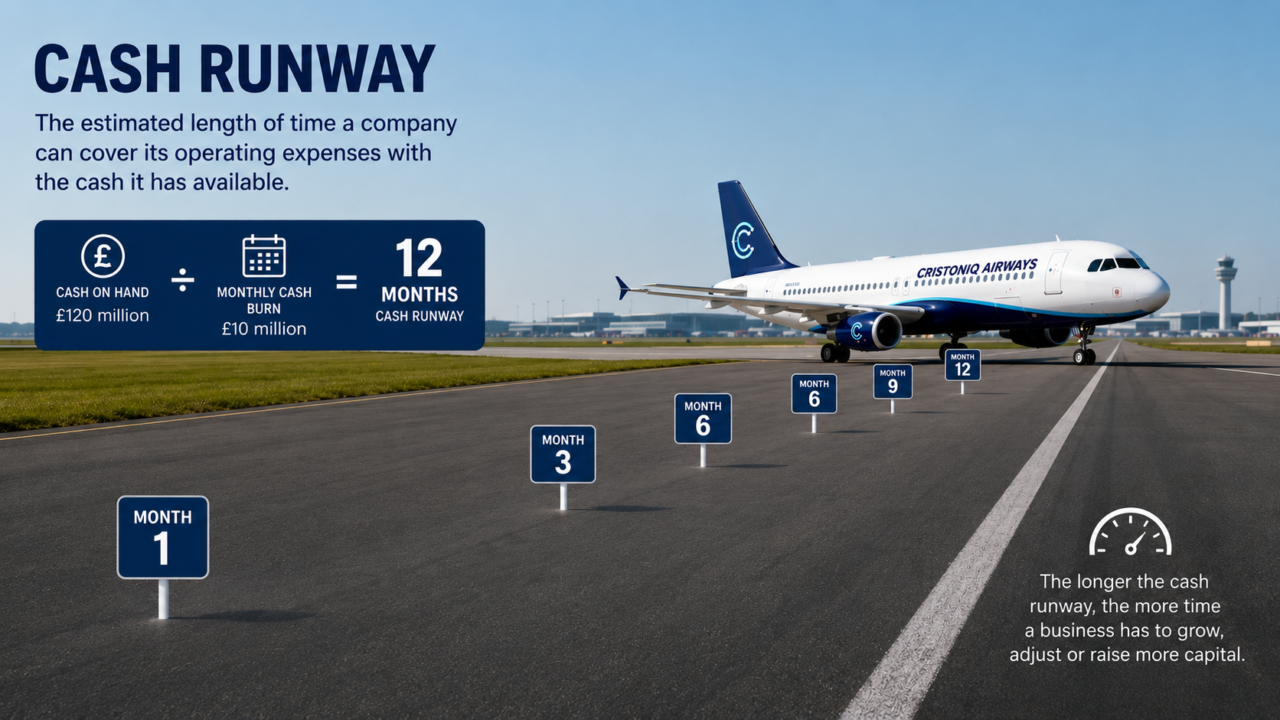
Cash runway is the time a company can keep operating before its cash runs out. It is usually estimated by comparing cash in the bank with the rate at which the company spends cash.
For a profitable company, runway may be less important because operations fund themselves. For an early-stage small-cap, it can be the first number to check.
The simple version is cash divided by monthly cash burn. If a company has GBP 12 million and burns GBP 1 million a month, the rough runway is twelve months. Real life is messier, but the habit is useful.
Small-cap investors should ask this before the story takes over. How long does the company have to prove the next milestone before it needs fresh money?
Why runway matters in small-caps
Small-cap companies often need outside funding. That is not automatically bad. A raise can fund growth, trials, drilling, product development or working capital.
The risk is timing. If a company raises from strength after good news, the terms may be acceptable. If it raises from weakness near the end of its runway, dilution can be painful.
Dilution means your percentage ownership falls because new shares are issued. The business may survive, but existing shareholders own a smaller slice.
The London Stock Exchange overview of AIM gives useful background on the market where many UK growth companies raise equity capital.
How to estimate runway without false precision
Start with the latest cash balance. Then look at operating cash outflow, capital spending, debt payments and any committed costs. Do not rely only on management’s confident wording.
Use a range rather than a single answer. If burn is GBP 800,000 to GBP 1.2 million a month, test both. The cautious case often tells you more than the hopeful case.
Also check whether spending is about to rise. A trial, factory ramp, drilling programme or sales push can shorten runway even when the last reported burn looked manageable.
The company may say it is funded to a milestone. That phrase is useful, but not complete. Ask whether the milestone itself is likely to unlock better funding terms.
Where the numbers can mislead you
Cash runway can look better than it really is when a company delays payments, cuts useful spending or receives one-off cash that will not repeat.
It can also look worse during a planned investment phase. A company may spend heavily before a launch, then reduce burn once the product is live.
That is why the cash flow statement matters. Profit and loss numbers can hide working capital swings, capital spending and one-off receipts.
Read management commentary beside the accounts. If the board says costs are controlled, check whether the cash flow agrees.
The dilution question
A short runway does not always mean trouble. It does mean dilution risk needs its own place in your notes.
Ask what price a raise might happen at, who would provide the money and whether existing shareholders are likely to get a fair chance to participate.
Placings, open offers and rights issues do not treat investors in exactly the same way. The structure can affect how much dilution private shareholders face.
The worst pattern is repeated emergency funding. Each raise is presented as the one that gets the company to the next stage, but the stage keeps moving.
Questions to ask before the next update
When is the next result, trial readout, production update or contract decision? A runway is most useful when you compare it with the next evidence point.
Does the company have debt, convertibles or warrants that could affect future funding? These instruments can change the dilution picture.
Is the market currently willing to fund similar companies? Even a decent company can struggle to raise on fair terms when the sector is out of favour.
Has management raised money earlier than it implied before? Past behaviour is not proof, but it is useful evidence about communication quality.
A Worked Example
Imagine a small biotech has GBP 18 million in cash and burns GBP 1.5 million a month. The rough runway is twelve months. A trial readout is expected in nine months.
That looks workable, but only if costs stay stable and the trial is not delayed. If the readout slips by six months, the company may need to raise before the key evidence arrives.
Now imagine a small software company with GBP 6 million cash and GBP 300,000 monthly burn. The headline runway is twenty months. If churn is falling and sales are improving, the runway may be enough to reach break-even.
The same calculation gives different risk signals because the business models are different. That is why runway belongs beside sector context, not in isolation.
A mining explorer gives a third case. It may have enough cash for routine overheads, but not enough for the next drilling programme. The stated runway then misses the real funding need.
In each example, the question is not only how many months remain. It is whether enough money exists to reach the event that could improve the company’s position.
What This Means For You
Before you get excited about a small-cap story, write down the runway. Then write down the event that must happen before the next raise becomes likely.
If the runway is short, position size should reflect that risk. A good idea can still be unsuitable if the funding clock is too tight.
Also revisit the number after every result, placing, acquisition or delay. Runway changes quickly when costs move, milestones slip or markets become less willing to fund risk.
Do not let a strong narrative hide a weak balance sheet. The story may be interesting, but the funding clock decides how much time it has before shareholders face dilution or worse terms later.
In Plain English
Cash runway tells you how long a small-cap has before money may become the main issue. It does not decide the investment case, but it can decide the timing risk.
Disclaimer: The value of investments can go down as well as up, and you may get back less than you invest. This article is for informational and educational purposes only and does not constitute financial advice. Always do your own research and consider seeking independent advice before making any investment decision.
This post is adapted from The Little Book of Small-Caps. Used with permission.