What are AI guardrails, and what can they actually do?
AI guardrails are filters, checks and workflow controls around AI systems. They reduce risk, but they do not make any system foolproof.
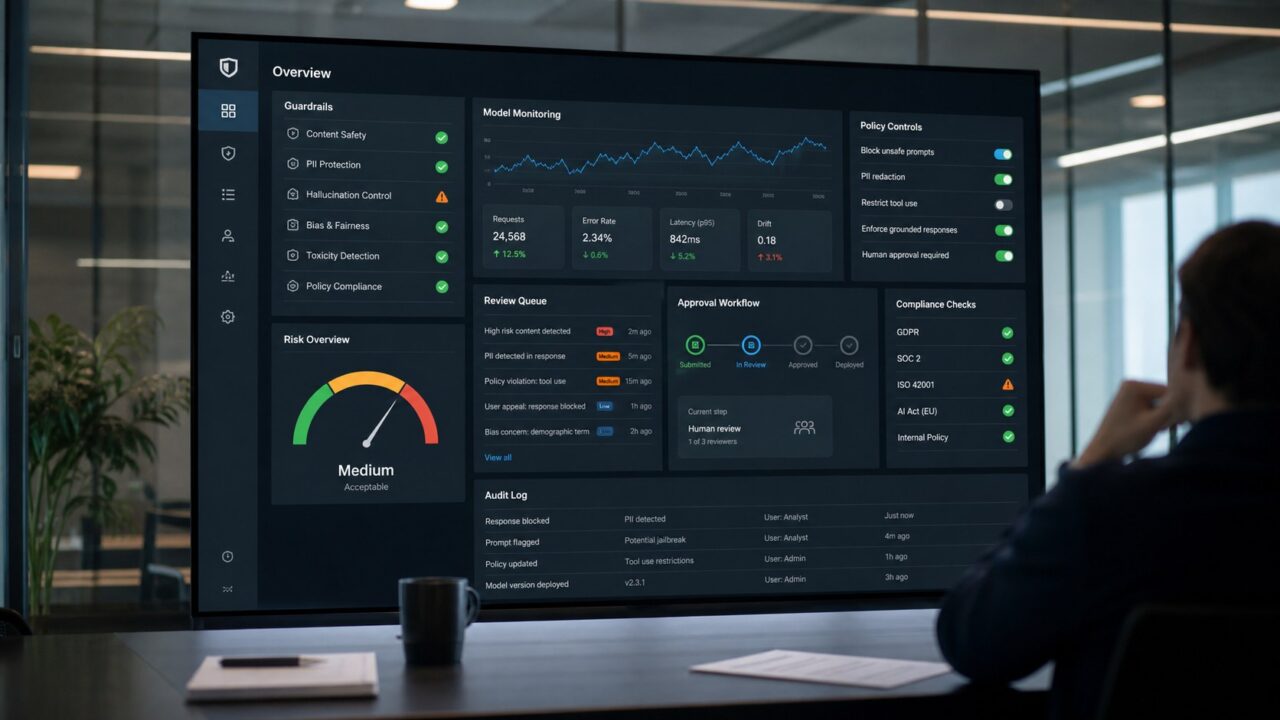
AI guardrails sound reassuring, as if a model has a fence around it and cannot wander into trouble. The reality is more useful, and less magical: guardrails are controls around an AI system that reduce the chance of unsafe, wrong or unwanted behaviour.
The Short Version
- AI guardrails are rules, filters, checks and workflow controls around an AI model.
- They can block some unsafe requests, flag risky answers, protect sensitive data and route decisions to a person.
- They matter most when AI connects to tools, files or customers.
- They reduce risk, but they do not make an AI system foolproof.
- The best guardrails are matched to the task, tested often and backed by human judgement where the cost of being wrong is high.
What An AI Guardrail Actually Is
An AI guardrail is any control that tries to keep an AI system within an acceptable boundary. That boundary might be about safety, accuracy, privacy, tone, legal exposure, brand rules, security or simply usefulness.
In a simple chatbot, a guardrail might be a content filter that refuses certain requests. In a business system, it might be a set of checks before the AI can send an email, approve a refund or search a private knowledge base. In a customer-facing product, it might include logging, escalation routes and rules about which topics must be handed to a trained human.
This is why guardrails are broader than prompts. A system prompt can tell a model how to behave, and our guide to system prompts explains why that matters. But a prompt is still only one instruction layer. Real guardrails combine instructions, classifiers, permission limits, monitoring, retrieval rules and human review.
The Main Types Of Guardrails
The first type is an input guardrail. It checks what the user, document or connected tool is asking the AI to process. That might mean blocking harassment, detecting attempts to override instructions, removing personal information or refusing a request that falls outside the product’s purpose.
The second type is an output guardrail. It checks what the model is about to return. A model might draft an answer that sounds plausible but includes unsafe advice, private information or a claim that is not supported by the source material. An output guardrail can block the answer, ask the model to try again, or send the case to a person.
The third type is a workflow guardrail. This matters when AI can take action. A chatbot that only writes text is one thing. An agent that can send messages, move files or run code needs tighter limits. Our explainer on what can go wrong when AI agents act on your behalf covers that risk.
The fourth type is a monitoring guardrail. This is less visible to users but often more important over time. It means tracking failures, reviewing edge cases and changing the system when people find new ways it can fail.
Why Guardrails Are Needed
Large language models are flexible because they respond to language. That is also why they are hard to control. They do not always know whether a sentence is a harmless instruction, a hostile instruction, a quote, a joke or a complaint.
Security bodies such as OWASP treat prompt injection as a core risk for large language model applications. In plain English, prompt injection is when text pushes the AI away from its intended instructions. The risk grows when the model can read emails, browse pages, inspect documents or use tools.
Guardrails are also needed because AI systems can be confidently wrong. A model can give a fluent answer without checking whether the answer is supported. This is why guardrails often sit alongside retrieval systems, citation checks and evaluation processes.
Finally, guardrails help with accountability. NIST’s AI risk framework treats trustworthy AI as a mix of reliability, safety, security, transparency, privacy and fairness. Guardrails do not deliver all of that on their own, but they help turn those goals into practical checks.
What Guardrails Can Do Well
Guardrails are useful at catching obvious boundary problems. A well-designed system can refuse requests that clearly violate policy, block some sensitive data, flag common abuse patterns and stop the AI from using tools it should not use. Amazon says Bedrock Guardrails can evaluate both user inputs and model responses. Google describes configurable safety filters in Vertex AI that use harm categories and thresholds. OpenAI describes moderation as a way to reduce unsafe content.
Guardrails are also good at adding friction. Friction is not a glamorous word, but it matters. If an AI assistant wants to delete a file, change a payment instruction or send a message to a customer, a confirmation step can prevent a small model mistake from becoming a real-world problem.
They can also make systems easier to improve. When a guardrail catches a failure, the team can inspect what happened: unclear instructions, poor source material, too much freedom or a filter set too tightly. That feedback loop is how AI products become more dependable.
Where Guardrails Fall Short
The most important limit is that guardrails are not perfect. A filter can miss harmful content. It can also block harmless content. A prompt can be bypassed. A model can misunderstand the task. A human reviewer can rubber stamp an answer without really checking it.
Guardrails also struggle when the boundary is fuzzy. “Do not give medical advice” is simpler than “be helpful but avoid implying certainty when evidence is weak”. “Do not reveal personal data” is simpler than “summarise this customer history without exposing anything unnecessary”. The more judgement a task needs, the harder it is to guardrail with a neat rule.
Another problem is overconfidence. A company can add a guardrail and start treating the system as safe. That is backwards. A guardrail is evidence that a risk has been considered, not proof that the risk has disappeared.
A Worked Example
Imagine a company adds an AI assistant to its customer support inbox. The assistant reads a message, checks the help centre and drafts a reply for the support team.
An input guardrail might remove payment card details before the message reaches the model. It might also flag a message that appears to contain hidden instructions telling the AI to ignore the company’s rules.
A retrieval guardrail might limit the assistant to approved help centre pages, rather than letting it invent a policy. An output guardrail might check for a refund promise, legal wording or unsupported claim. A workflow guardrail might require a human to approve any reply that mentions account closure, compensation or a vulnerable customer.
None of that makes the assistant perfect. It does make the system more sensible. The AI is useful for drafting, but the risky parts of the workflow have extra checks.
What This Means For You
If you are using an AI tool casually, guardrails explain why some requests are refused, softened or redirected. That can be frustrating, but it is usually the product trying to keep the model inside a chosen boundary.
If you are choosing or deploying AI at work, the better question is not “does it have guardrails?” Almost every vendor will say yes. Ask which risks the guardrails are designed for, what they block, what they miss, who reviews edge cases and what happens when the model is uncertain.
You should be most cautious when an AI system can affect someone else: customers, employees, patients, applicants or people whose data is being processed. In those situations, guardrails should support human judgement rather than replace it. Our guide to when not to use AI is the useful companion idea: sometimes the best guardrail is deciding the task should not be automated.
In Plain English
AI guardrails are the checks around an AI system that try to stop it doing the wrong thing. They can filter inputs, check outputs, limit permissions, require human approval and monitor failures. They are useful, especially when AI touches real systems or real people, but they are not a guarantee. Good guardrails reduce risk. They do not remove the need for judgement.
Related Reads
- What is prompt injection, and why can it fool AI systems?
- What are system prompts, and why do they matter?
- What can go wrong when AI agents act on your behalf?
- What is AI evaluation, and how do people test whether a model is safe to use?
- What is AI safety? Why its builders worry most
For source context, compare this with the NIST AI Risk Management Framework and the OWASP Top 10 for LLM Applications, which both stress testing, controls and clear limits around AI systems.