Crypto Daily 19 Apr: Relief Rally Stalls, Kelp Exploit Hits
Bitcoin slips back below $76k, a $292m Kelp DAO exploit rattles the restaking sector, and Fear and Greed sinks to 27.
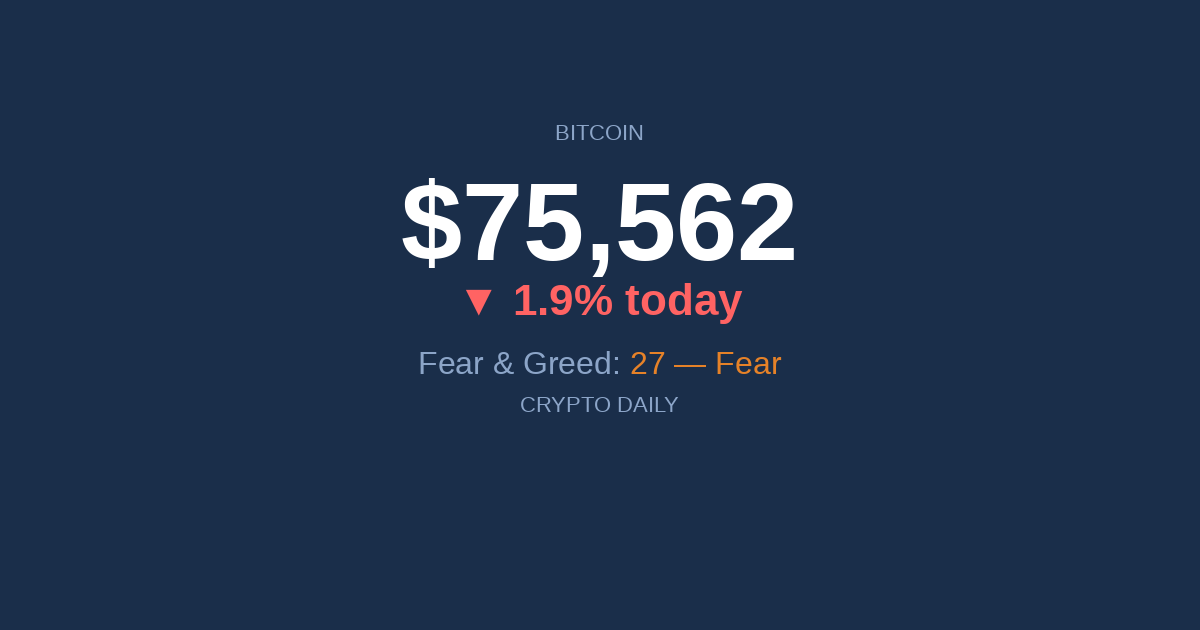
The relief rally that lifted crypto markets earlier this week ran into a wall of supply overnight. Bitcoin, at around $75,600 (roughly £60,500), is down nearly 2% after being rejected from the upper $77,000s, while a $292 million exploit at restaking protocol Kelp DAO has added a fresh layer of anxiety to an already cautious market. The Fear and Greed Index reads 27. This is not a market looking for reasons to buy.
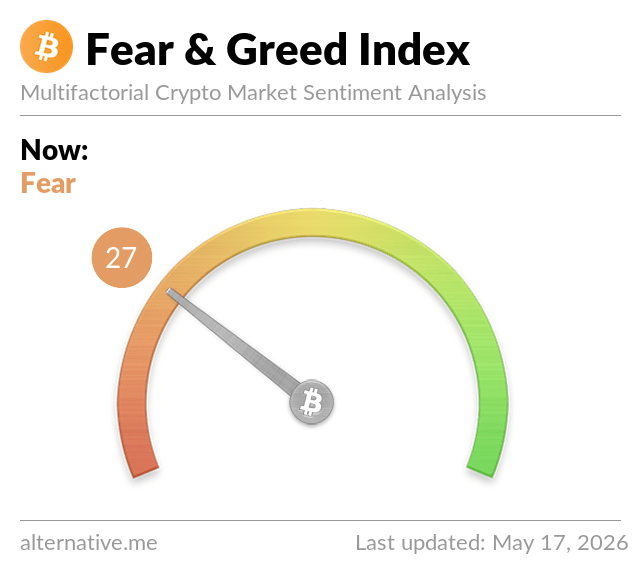
Total crypto market capitalisation sits at around $2.63 trillion, with aggregate 24-hour volume near $104.8 billion. Bitcoin accounts for approximately 57.4% of that total, a reading that typically signals traders are staying close to exits rather than reaching for speculative positions further down the risk curve. Ethereum’s share is around 10.7%, reinforcing the picture of a narrow market where capital is not rotating into alts. The Crypto Fear and Greed Index, a sentiment gauge that blends price momentum, trading volume and social activity on a scale of 0 to 100, reads 27 today. Sentiment is not just cautious in surveys; price action is confirming it.
| Timeframe | Regime | What it means |
|---|---|---|
| 1 hour | Neutral | Selling pressure has paused and BTC is marginally positive, but the move is too small to call a fresh recovery. |
| 4 hours | Bearish | BTC is still about 1.9% below where it started 24 hours ago, trading below short-term resistance with momentum fading after the squeeze. |
| Daily | Bearish | Bitcoin was rejected from the upper $77,000s and has slipped back toward $75,000, signalling daily buyers are losing control. |
| Weekly | Bullish | BTC is still up roughly 5.4% over seven days, keeping the broader recovery pattern of higher weekly lows intact. |
| Monthly | Bullish | A gain of about 7.3% over 30 days means the rebound from the spring selloff remains alive, even if short-term momentum has cooled. |
Bitcoin is at $75,562 (approximately £60,450), down 1.9% over 24 hours after failing to hold above $77,000. The week’s surge was driven heavily by a short squeeze: rapid, forced covering of bearish positions that cleared roughly $593 million in shorts in a compressed timeframe. That kind of move can look convincing in real time, but when it is liquidation-led rather than driven by fresh demand, follow-through dries up quickly once the forced buying is done. That is what is playing out today. On a longer view, the picture is less bleak. Bitcoin is still up about 5.4% over seven days and around 7.3% over 30 days, so the broader recovery structure from the spring selloff remains intact. Institutional signals remain constructive: Strategy adjusted its preferred-share dividend schedule and NYDIG flagged fresh corporate interest in bitcoin mining infrastructure. These are longer-term positives. For now, $75,000 is the level to hold. A clean break below it would reframe the week’s bounce as a bear market rally rather than a fresh trend leg.
Ethereum is at $2,341 (around £1,873), down 2.7% and underperforming Bitcoin by nearly a full percentage point. When ETH loses ground faster than BTC, it usually signals weaker risk appetite inside the smart contract ecosystem. The more immediate story is the Kelp DAO exploit. An attacker drained approximately $292 million in rsETH, a liquid restaking token used as collateral across multiple DeFi venues and chains, triggering emergency protocol freezes. Kelp is not the Ethereum network, but attacks of this scale create ripple effects across the entire DeFi stack: when a widely-used collateral token is frozen, every venue that accepted it faces simultaneous uncertainty. The support band between $2,300 and $2,350 is the key level. A clean break through it would prompt traders who bought the weekly rebound to question whether the recovery has genuine depth.
XRP is at $1.43 (roughly £1.14), down 2.6% today but still the strongest weekly performer in this group with a gain of over 7%. The catalyst behind that outperformance remains live: wrapped XRP has launched on the Solana network via a partnership between Hex Trust and LayerZero, giving XRP holders access to Solana’s DeFi ecosystem for the first time. That is a meaningful utility expansion and can support demand through short-term pullbacks. Today, though, it is not enough to override risk-off conditions. The low $1.40s are the defining line: hold there and the Solana integration story keeps its credibility; lose it and the breakout risks reverting into the range XRP held through most of March.
Solana is at $85.64 (approximately £68.50), off 3% and the weakest performer in the top five. The relative underperformance is notable partly because Solana is a direct beneficiary of the wrapped XRP launch, which brings new activity to the network. In a calmer tape, that might help SOL hold up better than peers. Instead, the market is treating it as high-beta exposure and selling accordingly. CoinGecko category data confirms this is broader than Solana specifically: both the Layer 1 and Proof of Stake baskets are down 2.3% and 3.1% respectively. SOL’s recovery target is the upper $80s. Until it reclaims that range, it remains among the more vulnerable names if selling deepens.
The Kelp DAO exploit is the standout structural story. Liquid restaking tokens like rsETH are composable by design: they can be used as collateral in lending protocols, bridged across networks and deposited into yield aggregators simultaneously. That composability is what makes them useful for sophisticated yield seekers. It is also what makes a major exploit systemically significant. When rsETH is frozen or devalued, every venue that accepted it as collateral faces uncertainty at the same moment. Whether today’s event triggers broader contagion depends on whether any lending protocol faces liquidation cascades as positions are unwound. That is the question the market will be watching over the next 48 hours. For the restaking sector specifically, this will reignite debates about audit standards and the risks of stacking complex yield structures on top of already-complex base protocols.
Three things are worth tracking closely from here. Bitcoin’s $75,000 level is the most immediate test: a close below it on meaningful volume would change the character of the week significantly. For Ethereum, the $2,300 to $2,350 zone carries similar weight, with the added overlay of whether Kelp DAO contagion spreads further into the lending and restaking space. Beyond the charts, macro sensitivity remains elevated. This market has shown it reacts sharply to geopolitical headlines around shipping and oil supply, and with Fear and Greed at 27, any fresh escalation would find a tape with limited capacity to absorb it.
Crypto Daily is Cristoniq’s daily guide to cryptocurrency markets. Published every morning for informational purposes only. Nothing here is financial advice. Always do your own research before making any investment decisions.