30 July 2026: Fear deepens as crypto stalls
Bitcoin holds near $63,900 while fear stays elevated, leaving Ethereum, Solana and Dogecoin stuck in a cautious crypto holding pattern.

Bitcoin is holding close to $63,900, or about £47,900, on Thursday morning after another subdued overnight session, and the bigger message from crypto markets is not that prices have broken decisively in either direction, but that fear is proving sticky while traders wait for a stronger reason to commit fresh capital.
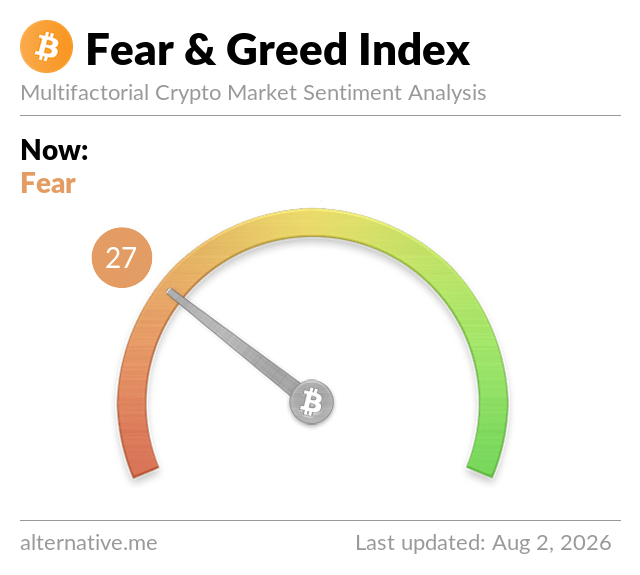
The total crypto market capitalisation stands near $2.27 trillion this morning, according to CoinGecko, after a modest daily slip, while Bitcoin dominance is about 56.5%. Bitcoin dominance measures Bitcoin’s share of the total crypto market, and a figure this high usually tells you money is staying in the largest asset rather than spreading confidently into smaller tokens. The Fear and Greed Index reads 28, in Fear territory, which means the market mood still leans defensive even though outright panic is absent.
| Timeframe | Regime | What it means |
|---|---|---|
| 1 hour | Neutral | Bitcoin is moving in a tight band, so the latest tick does not yet signal a clear break. |
| 4 hours | Bullish | Buyers have defended the overnight lows, which keeps the intraday tone slightly firmer than the headline move suggests. |
| Daily | Neutral | The one-day picture is balanced, with price still sitting between support near $63,250 and resistance around $64,660. |
| Weekly | Bearish | Bitcoin is still lower over seven days, which means short rallies are not yet enough to reset the broader mood. |
| Monthly | Neutral | The bigger structure is mixed rather than broken, so the market still needs a convincing catalyst to choose a direction. |
Bitcoin is trading at about $63,920, up only 0.1% over the past 24 hours, after moving between roughly $63,247 and $64,660 during the session.
That range says more than the daily percentage change. Bitcoin tried to push higher more than once, but each lift faded before it could hold above the top of the day’s band. At the same time, buyers kept stepping in above the overnight low, which is why the market still looks orderly rather than disorderly. For a general reader, that matters because quiet price action around a known range usually reflects hesitation, not conviction.
The wider seven-day move remains negative at about 2.5%, which fits the broader tone across risk assets: nobody is paying up aggressively for growth or volatility, but neither are they rushing for the exits. In other words, Bitcoin still looks like the asset institutions and larger traders would rather hold than most alternatives, yet it is not attracting the kind of inflow that normally starts a strong new leg higher. The so what is simple: Bitcoin is acting like a market anchor, but not yet a market leader.
Ethereum is changing hands near $1,902, effectively flat over 24 hours, after trading between about $1,875 and $1,926.
Flat can be deceptive here. Ethereum has not fallen apart, but it has also not shown much urgency relative to Bitcoin, and it remains down roughly 0.8% over the past week. When Ethereum underperforms during a cautious spell, it often signals that traders are not yet ready to broaden risk-taking beyond the biggest and most liquid names. That does not make Ethereum weak in any dramatic sense, but it does underline how selective the market still is.
There is also a practical point for UK readers following the asset class beyond price alone. Ethereum still sits at the centre of a large part of crypto’s stablecoin, tokenisation and decentralised finance activity, so muted price behaviour can coexist with a network that remains important. For background on how that policy and plumbing debate is evolving, Cristoniq’s UK crypto regulation timeline is a useful reference. The so what is that Ethereum still matters structurally, even when the market is reluctant to reward it in the short term.
Solana is around $73.56, up roughly 0.3% on the day, but still down about 5.0% over the past week.
That combination, a mild intraday bounce inside a heavier weekly decline, is typical of a higher-beta asset in a market that lacks confidence. Higher beta simply means an asset tends to move more sharply than the broader market. Solana can recover quickly when risk appetite improves, but it also tends to feel the drag more clearly when the mood turns cautious and volumes thin out.
Its 24-hour range, from about $72.36 to $74.42, shows there is still trading interest, yet not enough follow-through to turn a bounce into a convincing shift in direction. In a stronger market, readers would expect Solana to outpace Bitcoin rather than merely stabilise alongside it. The so what is that Solana still looks like a confidence trade, and confidence is exactly what the market lacks this morning.
Dogecoin is hovering around $0.0700, down about 0.7% over 24 hours and roughly 3.3% over the week.
That makes it the clearest example of what happens when speculative energy drains out of the market. Dogecoin does not need a complicated on-chain explanation for every quiet session. Its price often tells you whether retail appetite, meaning enthusiasm from smaller individual traders, is building or fading. Right now, the answer looks closer to fading.
Because Dogecoin relies so heavily on sentiment, even a small pullback matters as a signal. When fear remains elevated and Bitcoin dominance stays firm, tokens with the loosest fundamental anchor are usually the first to lose momentum. The so what is that Dogecoin is confirming the defensive tone rather than challenging it.
The more useful story this morning is not a single headline, but the persistence of defensive market structure across the whole complex.
Total market capitalisation slipped by about half a per cent over 24 hours, while volume rose only modestly. That combination suggests activity is still happening, but without broad conviction behind it. The Fear and Greed reading fell from 29 to 28, so sentiment has not improved even after Bitcoin held above the lower end of its range. When the largest asset stays relatively firm, the market cap eases, and the fear gauge stays weak, the usual interpretation is that capital is staying cautious rather than rotating into fresh opportunity.
That also helps explain why the overnight conversation in crypto still feels more defensive than adventurous. Traders appear willing to hold core positions, but less willing to chase breakouts, increase leverage, or pile into the more speculative corners of the market. If you need a plain-English parallel, this is the crypto equivalent of investors keeping a coat on because the sun has appeared briefly, but nobody trusts the weather enough to leave it at home. For readers thinking about risk rather than headlines, Cristoniq’s explainer on what happens during a stablecoin depeg is a good reminder of why defensive positioning matters when confidence is thin.
What to watch next is fairly clear. First, Bitcoin needs a clean move back through the $64,660 area, the top of the past day’s range, to suggest buyers are finally gaining control. Second, if price slips back toward $63,250 and fails to hold, the market is likely to interpret that as proof that the overnight stability was only a pause. Third, watch whether Ethereum can start outperforming Bitcoin rather than merely tracking it, because that would hint at broader risk appetite returning. Finally, keep an eye on the Fear and Greed Index itself: a move out of Fear and toward Neutral would not guarantee a rally, but it would tell you the market mood is at least becoming less defensive.
Crypto Daily is Cristoniq’s daily guide to cryptocurrency markets, published every morning for informational purposes only. Nothing here is financial advice. Always do your own research before making any investment decisions.