Crypto Daily 12 Apr: Ceasefire Fades, Privacy Coins Surge
Bitcoin slips to $71,560 as the Iran ceasefire rally loses steam. Zcash surges 46% on the week. Fear and Greed sits at 16.

Bitcoin gave back part of its ceasefire gains on Saturday, sliding 1.6% to $71,560 as the initial euphoria from last week’s Iran deal cooled and the broader market drifted back into deep fear territory. The real story this week, though, belongs to Zcash, which has torn nearly 46% higher in seven days on a collision of regulatory tailwinds, a supply squeeze, and a Grayscale ETF filing that has woken up the entire privacy coin sector.
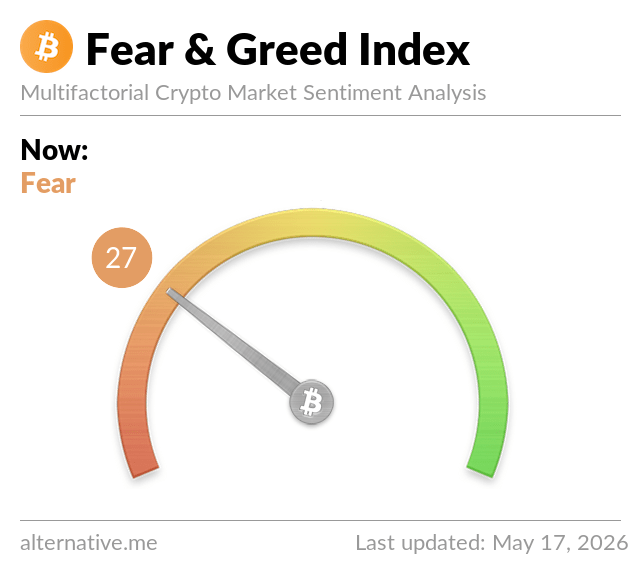
The total crypto market cap sits at $2.51 trillion, down 1.3% over the past 24 hours. Bitcoin dominance remains elevated at 57%, which tells us capital is not rotating into altcoins with any conviction. The Fear and Greed Index, a composite measure of market sentiment drawn from volatility, volume, social media and surveys, reads 16 out of 100 today. That is deep in Extreme Fear, the kind of reading more commonly associated with capitulation lows than orderly pullbacks. Whether this is a contrarian buy signal or a warning of further pain depends on what happens next with macro data and the ceasefire timeline.
Bitcoin traded as high as $73,721 in the past 24 hours before sellers stepped in and pushed it back below $72,000. On the week, it is still up 6.6%, entirely thanks to the ceasefire rally that began on 7 April when Trump announced a two-week halt to hostilities between the US, Israel and Iran. The reopening of the Strait of Hormuz sent oil down 16% and gave risk assets across the board a lift. But the follow-through has been unconvincing. The Coinbase Premium Index, which tracks the price difference between Coinbase and offshore exchanges, has been flipping between positive and negative, suggesting that American institutional buyers are not piling in with any urgency. Open interest in Bitcoin futures sits at around $24.2 billion, which is the highest since early March but still roughly half the $42 billion peak from October 2025. Funding rates, the periodic payments exchanged between long and short traders in perpetual futures, have stayed mostly negative throughout April. That means short sellers are paying to hold their positions, a sign of bearish conviction in the derivatives market. The flip side is that this creates the conditions for a short squeeze if a catalyst arrives. For now, Bitcoin is stuck between the ceasefire-driven floor near $71,500 and resistance around $73,700. A clean break above that level would need fresh buying, and the data does not yet show it arriving.
Ethereum edged down 1% to $2,213 (roughly £1,660) but remains one of the stronger performers on the week, up 7.7%. The Ethereum Foundation announced this week that it will convert 5,000 ETH, worth approximately $11 million, into stablecoins via CoWSwap to fund ongoing operations and grants. The sale is being executed using a time-weighted average price strategy to minimise market disruption, and so far the market has absorbed the news without flinching. More significant is the Foundation’s decision to stake around 70,000 ETH from its reserves, including a record $93 million single-day deposit on 3 April. That is a meaningful shift in how the Foundation manages its treasury. The staking commitment signals confidence in the network’s long-term economics, even as the Foundation sells smaller amounts for day-to-day expenses. Ethereum is still trading 55% below its August 2025 all-time high of $4,946, and the ratio against Bitcoin continues to look weak. But the on-chain picture is more constructive than the price suggests.
Zcash is the unmistakable standout this week. ZEC sits at $359.82, down 2.8% today but up a staggering 45.8% over the past seven days. The rally has several interlocking drivers. The SEC gave Zcash a regulatory green light in January, distinguishing it from assets under securities scrutiny. Grayscale then filed to convert its Zcash Trust into a spot ETF on NYSE Arca, the first serious institutional product for a privacy-focused cryptocurrency. On the supply side, roughly 30% of all ZEC now sits in shielded addresses, up from just 8% in early 2024. That fourfold increase means a significant portion of the circulating supply is effectively locked away from exchange-traded markets, tightening the float available to buyers. Foundry Digital, one of the largest Bitcoin mining operations, is reportedly planning an institutional-grade mining pool for Zcash, which would bring serious hash power and credibility. Spot inflows hit record levels for 2026 this week. The privacy coin trade looks like it has real institutional backing behind it now, not just speculative froth.
Solana dropped 2.5% to $82.26, making it the weakest of the top five by market cap today. On the week it is up a modest 2.1%, lagging both Bitcoin and Ethereum. SOL benefited from the March SEC-CFTC joint ruling that designated it, along with 15 other tokens, as a digital commodity rather than a security. That decision removes the most significant regulatory barrier to a Solana spot ETF. But the price has not responded with the enthusiasm you might expect. Part of the issue is that Solana is still trading 72% below its January 2025 all-time high of $293, and the recovery has been painfully slow. Developer activity and network usage remain strong, but the token price is telling a different story.
Cardano had the toughest day among the large caps, falling 3.6% to $0.243 and sitting 1.5% lower on the week. ADA has not found a narrative to latch onto in the way that privacy coins or even meme coins have. The broader L1 sector is mixed, and Cardano is on the wrong side of the split.
The story beyond the price tickers this week is the quiet but consequential progress of UK crypto regulation. On 4 February, Parliament passed the Financial Services and Markets Act 2000 (Cryptoassets) Regulations 2026, which brings crypto firmly within the FCA’s remit. The new regime is set to come into force on 25 October 2027, with a pre-application support window opening in July this year and formal applications accepted from 30 September. The FCA is also opening its regulatory sandbox for stablecoin testing and has named stablecoin payments as a priority for 2026. For UK-based investors and firms, this is the clearest signal yet that crypto is being pulled into the mainstream regulatory framework. The timeline is deliberate, not rushed, and the sandbox approach suggests the FCA wants to get this right rather than fast. It is worth paying attention to the consultation papers being published over the coming months, as they will shape what products and services are available to UK consumers.
Looking ahead, the most immediate event is Monday’s Producer Price Index release from the US Bureau of Labor Statistics. March consumer prices came in hot, with the largest monthly increase since June 2022 pushing the annual rate to 3.3%. A cooler-than-expected PPI print would ease pressure on the Federal Reserve and could be the catalyst that Bitcoin’s short-squeezable derivatives market is waiting for. A hot print would do the opposite. Beyond that, watch the $73,700 resistance level on Bitcoin. A daily close above it with rising volume would suggest the ceasefire rally has legs. A failure there, especially on declining volume, points to further consolidation or a retest of $70,000. The Iran ceasefire itself expires in roughly ten days. If it is extended, risk assets should hold their gains. If it collapses, expect a swift repricing.
This is a daily market update for informational purposes only. Crypto markets are highly volatile and prices can change significantly in minutes. Nothing here is financial advice. Always do your own research before making any investment decisions.
Crypto Daily is Cristoniq’s daily guide to cryptocurrency markets, published every morning.