28 May 2026: Bitcoin slides as fear reading hits 22
Bitcoin drops below $73,000 as Extreme Fear returns. Here is the market snapshot, key coins, and the levels and events to watch for UK readers today.

Bitcoin is lower again this morning, trading near $72,709 (about £54,136) as a weak month and an Extreme Fear sentiment reading keep traders cautious.
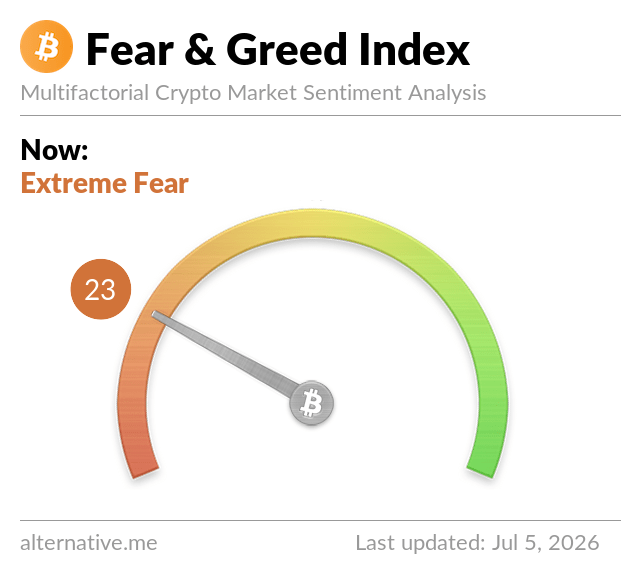
Market overview: Total crypto market value is about $2,524,737,012,048 (CoinGecko), with Bitcoin dominance near 57.7% and Ethereum around 9.4%. The Fear and Greed Index is 22 (Extreme Fear), a 0 to 100 sentiment gauge where lower numbers reflect more fear.
The headline numbers point to the same thing: this is still a de risk environment. When sentiment is this low, headlines move prices more than usual, and short term bounces can look bigger than they are.
| Timeframe | Regime | What it means |
|---|---|---|
| 1 hour | Neutral | Short term move is small (-0.3%), so the latest price is best read as noise rather than signal. |
| 4 hours | Bearish | The last few hours have been softer (-1.9%), which fits with the wider risk off tone. |
| Daily | Bearish | Over 24 hours BTC is lower (-3.9%), suggesting sellers still have the upper hand today. |
| Weekly | Bearish | The week is down (-6.4%), which means rebounds can fade quickly. |
| Monthly | Bearish | The last month is still negative (-5.5%), so sentiment remains fragile. |
Bitcoin (BTC): $72,709 (about £54,136), -3.9% over 24 hours.
On a day like this, the most useful question is not where Bitcoin goes next, but what the move is telling you about risk appetite. A four percent slide in 24 hours, on top of a negative week, is a reminder that the market is still looking for a reason to lean in.
In practical terms, Bitcoin is back to doing what it does in nervous periods: it trades as the market’s proxy for confidence. If you are a long term holder, the key is not the exact print at 6am, it is whether the selling stays orderly or starts to cascade through the day.
So what: Extreme Fear does not tell you what happens next, but it does tell you to expect choppy price action and to treat any single headline move with scepticism.
Ethereum (ETH): $1,972.38 (about £1,469), -5.0% over 24 hours.
Ethereum is falling faster than Bitcoin today, which is common when the market is de risking. ETH tends to carry more cyclical risk because it is tied to activity across decentralised finance and token launches.
If you are using ETH rather than trading it, the day to day move matters less than whether network fees and usage are picking up. When activity is quiet, the price is more exposed to broad mood swings.
So what: A softer ETH tape usually means the market is not ready for a broad altcoin rotation yet.
Solana (SOL): $80.51 (about £60), -3.9% over 24 hours.
Solana continues to behave like a high beta bet on risk appetite. When the market turns defensive, faster chains and meme driven activity often cool quickly, and SOL can fall in line even without fresh SOL specific news.
If you are trying to understand why liquidity matters so much in these moves, our explainer on liquidity in crypto is a good place to start.
So what: SOL is a useful barometer for retail risk taking, and right now that appetite looks subdued.
BNB: $631.36 (about £470), -3.2% over 24 hours.
BNB is down in line with the rest of the market. In calmer periods it can trade more steadily than other large caps, but when Bitcoin is sliding it is difficult for anything to stay insulated.
For readers learning the plumbing of crypto markets, it is worth knowing how token utility differs between centralised exchanges and decentralised exchanges. Utility does not guarantee price support, but it explains why some coins hold attention longer than others.
So what: In risk off stretches, the market often prices convenience and liquidity over new narratives.
XRP: $1.28 (about £1), -3.9% over 24 hours.
XRP is moving with the pack rather than setting the tone. That is not a criticism, it is just what a correlation driven day looks like. When sentiment is in Extreme Fear, nuance gets crowded out.
So what: If a coin is not tied to the day’s main narrative, it can still swing hard because traders treat the whole market as one risk bucket.
One story worth knowing: The Fear and Greed Index has slipped to 22 (Extreme Fear). It is a simple composite that blends price momentum, volatility, volume and social signals into a single number. It is not a timing tool, but it is useful context for how fragile conviction is.
The risk with Extreme Fear is not that it makes prices fall on its own, but that it makes the market jumpy. When people feel exposed, small bits of news can trigger big moves because there are fewer confident buyers willing to lean against the crowd.
For UK readers, the practical takeaway is behavioural rather than technical: if you are investing, separate your time horizon from the market’s mood. If you are learning, treat days like this as a reminder of how quickly sentiment can change.
What to watch: The most obvious line in the sand is the $72,000 area in Bitcoin, simply because it is close enough to be tested again. A clean move below it would signal that sellers are still in control, while holding it would suggest the market is stabilising after the overnight slide.
Also watch whether Ethereum can stay near $2,000. That level is not magic, but it is a round number that tends to concentrate attention. If ETH breaks lower while BTC is steady, that usually points to investors trimming higher risk exposure.
Finally, keep an eye on the tone of the next major US inflation update. Crypto often reacts less to the number itself than to how it changes expectations for interest rates, and that feeds straight into risk appetite.
Crypto Daily is Cristoniq’s daily guide to cryptocurrency markets, published every morning for informational purposes only. Nothing here is financial advice. Always do your own research before making any investment decisions.