23 May 2026 PM: Altcoins Bear the Brunt as Bitcoin Dominance Climbs Above 58%
Bitcoin tests $74,700 on Saturday as rate hike fears drive crypto lower. Altcoins lead the losses, with Sui down 9.5% and Solana falling 6%.

Bitcoin slipped to a fresh afternoon low of around $74,300 on Saturday before settling near $74,700, as rising expectations of a US interest rate hike kept risk appetite subdued across crypto markets. Altcoins bore the brunt of the session, with Sui shedding nearly 10% and Solana falling close to 6%, while Bitcoin dominance climbed above 58%, reflecting investors’ preference for the largest digital asset as a form of relative shelter within the asset class.
The total cryptocurrency market capitalisation stands at approximately $2.58 trillion, down around 3.3% over the past 24 hours. Bitcoin’s share of that total has risen to 58.1%, its highest point in recent sessions. When broader risk-off conditions take hold, investors tend to rotate from smaller coins toward Bitcoin, partly because it is the most liquid and most widely held digital asset, and partly because its narrative is simpler to defend in uncertain conditions. This morning’s Crypto Daily covered the early session, when Bitcoin was trading around $75,000 following overnight selling. The afternoon brought further losses rather than recovery.
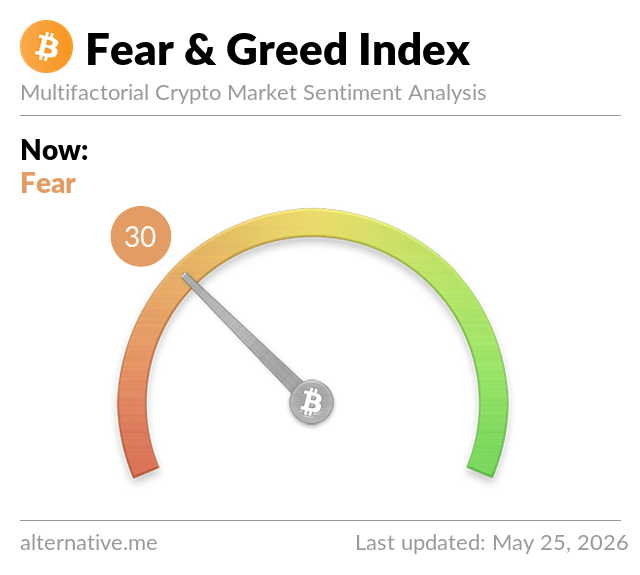
The Fear and Greed Index, which combines signals including price momentum, social media activity, and market volatility to produce a single sentiment reading from 0 (extreme fear) to 100 (extreme greed), remains at 28, in Fear territory. The reading has held at that level throughout Saturday, suggesting sentiment has not improved since the morning session. A reading below 30 indicates market participants are broadly cautious and selling pressure is the dominant force. The index is a snapshot of current mood, not a forward indicator.
| Timeframe | Regime | What it means |
|---|---|---|
| 1 hour | Bearish | Bitcoin hit its 24-hour low of $74,344 in the afternoon, indicating short-term selling pressure has not exhausted itself |
| 4 hours | Bearish | The four-hour trend remained consistently lower across Saturday, with no meaningful recovery sustained |
| Daily | Bearish | Bitcoin is down around 3.4% on the day, tracking below the opening price throughout the session |
| Weekly | Bearish | Bitcoin has declined around 4.3% over the past seven days, continuing a run of weekly losses |
| Monthly | Bearish | Down roughly 3.9% over 30 days, with Bitcoin stuck below its 200-day moving average at $82,228 throughout this period |
Bitcoin fell by around 3.4% over the past 24 hours, reaching approximately $74,700 (around £55,600), with a 24-hour trading range running from a high of $77,434 down to a low of $74,344 printed this afternoon. Bitcoin has spent the better part of this month below its 200-day moving average, a long-term trend indicator sitting at around $82,228, which has acted as a ceiling for any recovery attempt. Trading volume over the past 24 hours reached approximately $32.7 billion, moderate rather than elevated, suggesting this is a sustained drift rather than a sharp capitulation event.
The pressure is macro rather than crypto-specific. US Treasury yields have risen to around 4.54% on the 10-year note, close to 12-month highs, and CME FedWatch data now prices a probability above 50% that the Federal Reserve will raise interest rates before the end of 2026. That context matters because when risk-free government bonds offer higher returns, the relative appeal of holding zero-yield assets like Bitcoin is reduced. The mechanism is straightforward: a portfolio manager holding Bitcoin alongside conventional bonds faces a different calculation when those bonds offer 4.5% compared to 2.5%. The evidence suggests that calculation is leading some institutional holders to reduce exposure.
The 24-hour low of $74,344 is the immediate level to track. A sustained close below $74,000 would open the question of a further leg lower, while a recovery above $77,000 would suggest buyers are beginning to absorb the current pressure.
Ethereum fell by around 4.6% over the past 24 hours to approximately $2,029 (around £1,510), touching a 24-hour low of $2,021 and briefly testing the $2,000 level during the afternoon session. Over seven days, Ethereum has declined by nearly 7%, a steeper rate than Bitcoin’s 4.3% weekly fall, which partly explains the rise in Bitcoin dominance. The 30-day picture is more pronounced: Ethereum has dropped roughly 13% over the past month. The $2,000 level is not a technical target derived from any formula; it matters because many participants treat it as a reference point, and a daily close below it would attract attention as a further negative signal. Whether it holds will depend on whether Bitcoin stabilises over the weekend.
Solana fell by around 5.7% over the past 24 hours, dropping to approximately $82.23 and reaching an afternoon low of $81.73. There is no Solana-specific catalyst behind today’s move: the decline mirrors the pattern across the altcoin market rather than reflecting anything specific to the project. What happens to the macro backdrop and to Bitcoin is the relevant factor for where Solana goes from here.
Sui, a layer-1 blockchain designed around high transaction throughput, fell by around 9.5% over the past 24 hours, dropping from an intraday high of $1.13 to a low of approximately $0.99 before recovering slightly to around $1.00. The scale of Sui’s decline stands out relative to Bitcoin and Ethereum, and reflects a consistent pattern: assets with smaller market capitalisations and more speculative demand tend to fall faster and further than the largest coins when risk appetite contracts. Sui’s market cap of around $4 billion means a shift in sentiment can produce moves of this size in a matter of hours. There is no project-specific news behind today’s decline. For context on how assets like Sui connect to broader on-chain infrastructure, our explainer on crypto bridges covers how capital moves between chains. The so what: Sui’s outsized decline today reflects the risk-off mood amplified through a smaller asset, and assets in this category tend to take longer to recover relative losses than Bitcoin or Ethereum in a sustained downturn.
The clearest story running beneath Saturday’s price action is the connection between US interest rate expectations and crypto market performance. The shift in CME FedWatch data, from pricing multiple rate cuts at the start of 2026 to pricing a greater-than-even chance of a rate hike before the year ends, represents a fundamental change in the backdrop that crypto has been trading against. Higher rates reduce the appeal of zero-yield assets, and the relationship has become more direct as institutional participation in the asset class has grown. When bond yields rise, managers of large pools of capital run arithmetic on their portfolios, and assets that produce no income are vulnerable to that arithmetic.
One development worth noting alongside this is the continued growth of tokenised Treasuries, on-chain instruments that hold US government debt and pass the yield through to holders. The on-chain market value of tokenised Treasuries has exceeded $15 billion this month according to analyst data, a record. The figure is small in the context of the broader Treasury market, but its growth indicates that some capital that might previously have sat in stablecoins is moving toward yield-bearing on-chain products. The interest rate environment is reshaping where money sits even within the crypto ecosystem, not only in flows between crypto and traditional finance.
The immediate level to watch for Bitcoin is the $74,344 low printed this afternoon. A close below $74,000 over the weekend would be a meaningful negative signal and could bring further selling when US markets reopen on Monday. Conversely, a recovery back above $76,000 before the weekend closes would indicate the selling has been absorbed. Ethereum’s $2,000 level is the second marker: the 24-hour low of $2,021 came close on Saturday, and how Ethereum closes the weekend relative to that level will set the tone for early next week.
US spot Bitcoin ETF flow data on Monday is the third thing to track. Earlier this month, spot Bitcoin ETFs recorded close to $1 billion in weekly outflows, a figure that reflected institutional holders reducing exposure rather than treating the dip as an opportunity. Whether that pace continues or moderates will say something meaningful about institutional conviction at current price levels. Any scheduled commentary from Federal Reserve officials in the coming days will also be parsed closely: a below-expectations reading on upcoming US inflation data is the macro development most likely to offer crypto markets genuine relief, while an above-expectations number would push rate hike probabilities higher and add further headwind.
Crypto Daily is Cristoniq’s afternoon update on cryptocurrency markets, published every weekday for informational purposes only. Nothing here is financial advice. Always do your own research before making any investment decisions.